Frederick Polydore Nodder (fl. 1770-1800) (artist and engraver)
George Shaw (1751-1813) (descriptions)
Reptiles and Amphibians
from
The Naturalist's Miscellany: Or, Coloured Figures Of Natural Objects; Drawn And Described Immediately From Nature
Nodder & Company, 15 Brewer Street, London: 1789-1813
Engravings hand-colored with watercolor and gouache
5.75 x 10 inches each
Sold, please inquire as to the availability of similar items.
To see other Shaw and Nodder natural history prints on our site, use our site search engine.
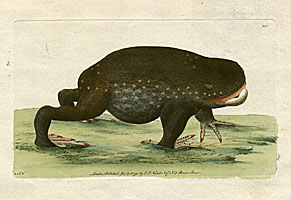
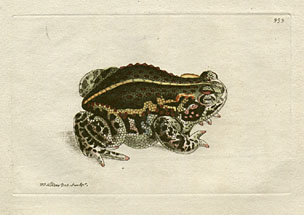
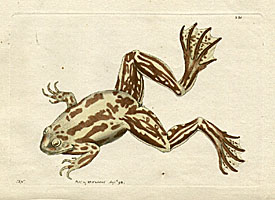
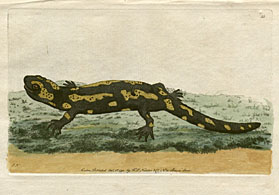
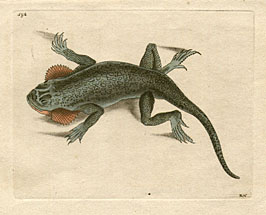
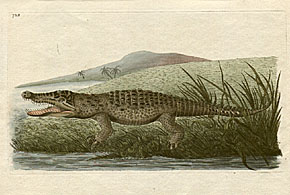
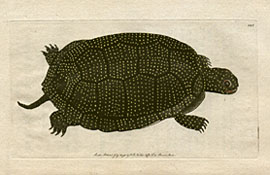
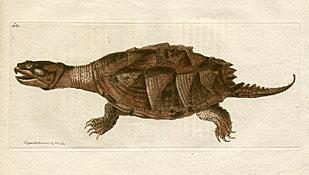
Natural history prints from a monumental work that originally ran to 24 volumes. The Naturalist's Miscellany is notable for its huge variety of animals, for the way many are imbued with distinctive whimsical personalities, and for the sheer visual appeal of its plates. Hand-colored with a combination of watercolor and layered gouache, the colors are particularly brilliant. We have in stock groups of brilliantly-hued butterflies; amphibians and reptiles such as frogs, turtles, and lizards, with beautiful patterns on their skin often reminiscent of marbleized designs; and colorful tropical fish, with stripes and other patterns.
The prints in this series were issued in groups monthly from 1789 to 1813. The English naturalist, George Shaw, wrote the text for this work, and the plates were drawn and engraved by natural history artist, Frederick P. Nodder. After Nodder's death in 1800, his son finished the illustrations.
George Shaw was a medical practitioner and a lecturer in botany at Oxford University, a founder of the Linnean Society of London and Keeper of the Natural History Section of the British Museum. He published one of the first English descriptions with scientific names of several of the common Australian animals. He was among the first scientists to examine a platypus and published the first scientific description of it in The Naturalist's Miscellany.
Frederick Polydore Nodder was a British natural history artist who illustrated both plants and animals. In addition to working on Shaw's The Naturalist's Miscellany, he also helped Joseph Banks prepare the Banks Florilegium and converted most of Sydney Parkinson's Australian plant drawings into paintings and helped engrave them for publication.
References:
Boese, Alex. "Duck Billed Platypus, The." The Museum of Hoaxes. http://www.museumofhoaxes.com/platypus.html (27 September 2002).
"Color Printing in the Nineteenth Century: Intaglio Processes." University of Delaware Library. http://www.lib.udel.edu/ud/spec/exhibits/color/intag2.htm (27 September 2002).
"Frederick Polydore Nodder." Australian National Botanic Gardens, Biography. http://www.anbg.gov.au/biography/nodder-frederick.html (27 September 2002).
McCarthy, G.J. "George Shaw." Bright Sparcs. Australian Science Archive Project: 20 August 2002. http://www.asap.unimelb.edu.au/bsparcs/biogs/P000777b.htm (27 September 2002).