Fish Studies
American: c. 1946
Watercolor, pen and ink, on paper
Provenance: Estate of the Artist
Sold, please inquire as to the availability of similar items.
To see other Charles Liedl paintings on our site, use our site search engine.

This item is sold. It has been placed here in our online archives as a service for researchers and collectors.
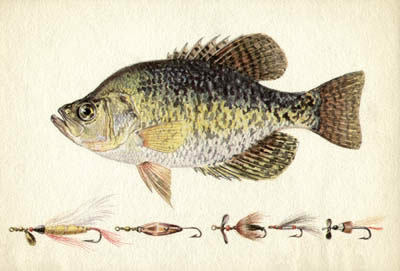
Calico Bass (Black Crappie),
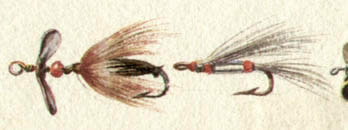
1-Heavy lure with spinner, 2-Spoon, 3-Spinner fly, 4-Bucktail, 5-Spinner fly
10 x 14.5 inches, overall
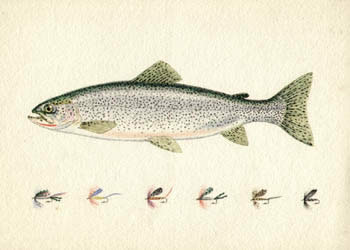
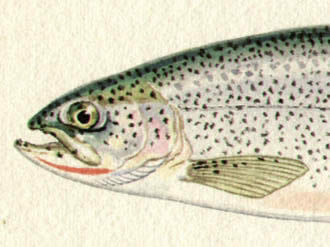
[Rainbow?] Trout with Fishing Flies
9 x 12.5 inches, overall
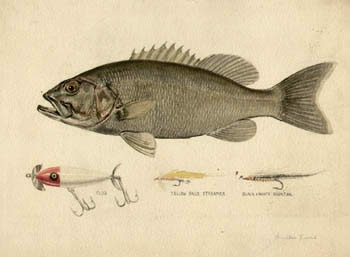
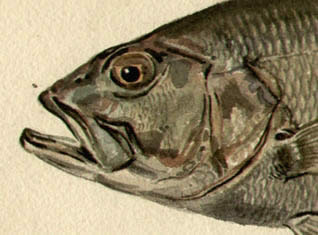
Bass with Fishing Lures
11.25 x 15.25 inches, overall
Signed lower right: Charles Liedl
To see other Charles Liedl paintings on our site, use our site search engine.
Natural history watercolors by Charles Liedl of fish, shown in profile, with appropriate lures lined up below them. These were apparently created as studies for a series of watercolors illustrating an article about the joys of fishing in Esquire magazine. The sizes of the paintings vary as indicated. All are guaranteed authentic from the artist’s estate.
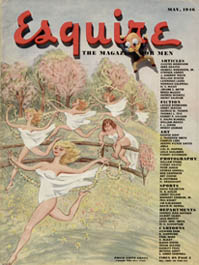
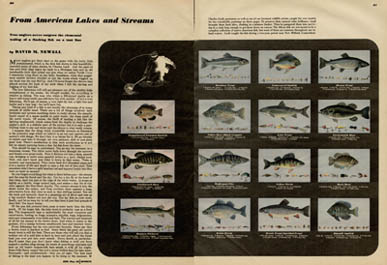
Fifteen of Liedl’s paintings, in the same format as the ones being offered here, were reproduced on a two-page spread in the May 1946 issue of Esquire with an article by David M. Newell titled From American Lakes and Streams (see reproductions below). Our paintings, from Liedl’s estate, were apparently made as studies for the article, as they are in the same format but on off-white paper; the published illustrations are on gray-toned paper. Calico Bass (Black Crappie), shown above top, is almost identical to the published version with only slight differences in coloration. Trout, shown above middle, is quite similar to the published version of the rainbow trout, but facing the opposite direction and with fewer lures. Bass, shown above bottom, in many respects resembles the published picture of the largemouth bass, though the published version has more patterning.
The caption for the illustrations gives some insight into Liedl’s working process:
Charles Liedl, sportsman as well as one of our foremost wildlife artists, caught his own models for the remarkable paintings on these pages. To preserve their natural color brilliance, Liedl brought them back alive, sloshing in a minnow bucket. Then he pampered them into surviving in a tank long enough to get them down on canvas. The fifteen fish are not meant to be complete collection of native American fish, but most of them are common throughout our inland waters. Liedl caught the fish during the two-year period near New Milford, Connecticut.
Charles Liedl was a renowned and prolific illustrator of hunting, fishing, and wildlife scenes. He was born in Hungary at the turn of the 20th century and studied at the Academy of Fine Arts. He published illustrations in hunting magazines, and became a soldier during World War I. Captured by the Russians, he was shipped to Siberia, transferred to American and then Japanese custody. After escaping around 1919, he found work in Japan painting pictures of orchids for a rich patron. He immigrated to the United States in the early 1920s, and began his career as an illustrator. In the 1930s and 1940s, he exhibited his works at various galleries and museums, including The American Museum of Natural History, Education Hall and the Heads & Horns Museum Gallery, New York Zoological Park. In 1948, Steuben Glass produced a series of glass game bird figurines after Liedl’s designs. An avid outdoorsman as well as an artist, he wrote and illustrated two instruction books on animal art: How to Draw Animals (Greenberg, 1953) and Hunting with Rifle and Pencil (Fredericton, New Brunswick: Brunswick Press, 1955). He also did the illustrations for a children’s animal book, Noel and Jimmy-Why by George Frederick Clark (Brunswick Press, 1959). Liedl oversaw the painting of the landscape backgrounds for the wildlife dioramas at the Seattle Museum of History and Industry in 1963.
Reference:
Newell, David M. “From American Lakes and Streams.” Esquire. May 1946. pp. 30-31 (shown below).
 |
 |