Jules Sebastien Cesar Dumont d'Urville (1790-1842) (editor)
Werner (painter)
Borromée (illustrator)
Giraud (engraver)
Roussette Insulaire (Female) Plate 5
[probably Pteropus Insularis]
from Voyage au Pole Sud et Dans L'Oceanie sur Les Corvettes L'Astrolabe et La Zélée...Pendant Les Années 1837, 1838, 1839, 1840 [Voyage to the South Pole and through Oceania on the Corvettes Astrolabe and Zélée...During the Years 1837, 1838, 1839, 1840]
Hand-colored aquatint
Paris: 1841-1854 (atlas volume)
20.75 x 13.5 inches, overall (folio)
16.25 x 10.75 inches, plate mark
Sold, please inquire as to the availability of similar items.

Natural History Bat Study
d'Urville's Voyage au Pole Sud
d'Urville's Voyage au Pole Sud
This item is sold. It has been placed here in our online archives as a service for researchers and collectors.
- Please inquire as to the availability of similar items currently in stock, or use the navigation bar above to browse our site for currently available items.
- Find guidelines for the use of images from georgeglazer.com.
- To see more archived items, view our directory.
- Find information about selling your art and antiques.
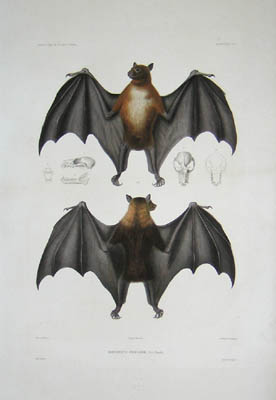
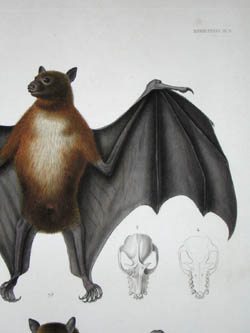
Natural history study of a bat, shown in a front and rear view, along with four illustrations of skull and jaw views. Its wings and head are black, with torso colored in a highlighted reddish-brown. The bat is probably what is known today as Pteropus Insularis, native to what is today known as Chuuk, an island group that comprises one of the four states of the Federated States of Micronesia.
A blind stamp appears in the lower center margin of the print saying, ¨Gide Editeur Paris." Voyage au Pole Sud... reported on the geography, geology, anthropology and natural history of Oceania and the South Pacific, which d'Urville had explored. He enlisted scientific collaborators to write and illustrate each section. The zoology section contained about 110 plates, including 29 of mammals.
Jules Sebastien Cesar Dumont d'Urville was a French navigator who surveyed and explored the Falklands, Oceania and the South Pacific on two voyages between 1822 and 1829. On his second circumnavigation of the world between 1837 and 1840, on the Astrolabe and the Zélée, he penetrated the ice pack south of New Zealand and discovered the Adélie Coast region of Antarctica, which he named for his wife. Earlier in his career, D'Urville encountered the newly-discovered Venus de Milo while surveying the Mediterranean, and brought it to the attention of the Louvre, where it remains a featured part of the collection. He published several books with scientific collaborators about his voyages, including this one.
Reference:
"Jules Sebastien Cesar Dumont d'Urville." The 1911 Edition Encyclopedia.
LoveToKnow Corp.: 2002. http://77.1911encyclopedia.org/D/DU/
DUMONT_D_URVILLE_JULES_SEBASTIEN_CESAR.htm
( 13 October 2003 ).