Friedrich Justin Bertuch (1747-1822)
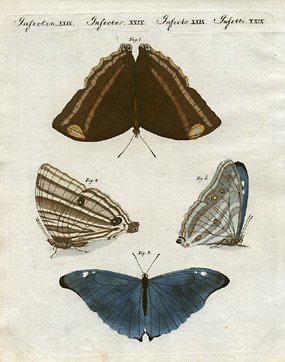
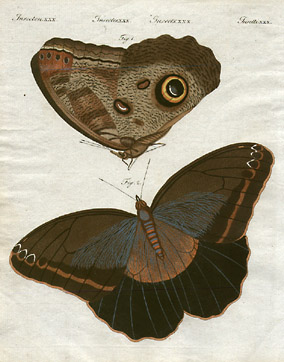
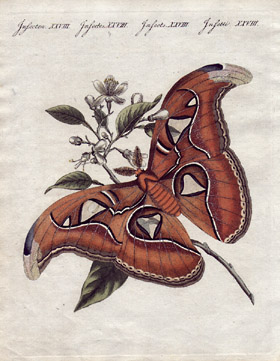
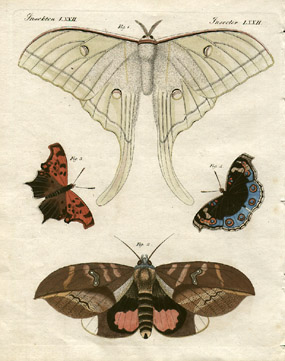
Four Butterflies:
The Brown Atlas Butterfly, Plate 28
Butterflies of Surinam, Plate 29
Butterflies of Surinam, Plate 30
Phalacna Attaci, Phalaena conspicillator, Papilio Caureum, Papilio Orithya, Plate 72
from
Bilderbuch für Kinder, enthaltend eine angenehme Sammlung von Thieren, Pflanzen, Blumen, Früchten, Mineralien, Trachten
[Children's Picture Book Containing a Delightful Collection of Animals, Plants, Flowers, Fruits, Minerals, Clothing]
Bureau of Industry, Weimar, Germany: 1792-1810
Hand-colored engravings
9.75 x 8 inches each
Sold, please inquire as to the availability of similar items.
To see other Bertuch natural history prints on our site, use our site search engine.
Plates from the first picture encyclopedia for children. Issued in 12 volumes it contained short articles written at a child's level of understanding about subjects such as zoology, botany, geology, geography, history and anthropology. Bertuch assembled the books according to his educational philosophy: the emphasis should be on illustrations that were "beautifully and correctly drawn," "selected and engraved from the best originals," in order to give children accurate information, while the text should be kept concise lest the child become confused or lose interest. He also felt that where possible, strange and rare phenomena should be featured to capture the child's attention and imagination. Therefore, the encyclopedia was illustrated throughout with vivid and detailed copperPlate engravings, that were scientifically accurate and sophisticated in their composition and execution. It was published in German, French and two other languages.
Friedrich Johann Justin Bertuch was a successful entrepreneur and very much a man of the 18th century Enlightenment, sharing the general preoccupation of the age with the correct education of young, as well as the categorization of knowledge. He saw education as a means of social progress and self-improvement for all classes of people. Bertuch was born in Weimar, where his father was a garrison physician in service to the duke. Orphaned at the age of 15, he lived with his uncle and pursued an education in theology and law. He learned Spanish and translated Don Quixote into German, and tried his hand at writing. At age 28 he was appointed the private secretary Schatullenverwalter to the young duke Karl August. Soon thereafter, he co-founded a school for workers and a factory for artificial flowers to provide "beneficial work" for "unfortunately unemployed" young women. He diversified his operation into publishing, training the workers in his school. He launched fashion magazines in 1786 and 1787 with which he could also advertise the products of his factories and he also established a cottage industry exchange for artisans and manufacturers to sell their goods. Bertuch became the largest employer in Weimar. In 1790, Bertuch began his major publishing project-- the first pictorial encyclopedia for children, a 12-volume work and a landmark in educational publishing whose vibrant illustrations are still admired today. His son Carl (or Karl) Bertuch (b. 1777) was also a writer and publisher, who associated with the leading scholars of his day, including Goethe, Cotta and Cuvier. Both Bertuchs traveled to the Viennese Congress in 1814 as part of a delegation of German booksellers to lobby for freedom of the press and copyright protection.
References:
"Buch des Monats (Book of the Month): August 1999." Deutches Museum. August 1999. http://www.deutsches-museum.de/bib/entdeckt/alt_buch/text0899.htm (23 June 2003).
"F. Justin Bertuch." Virtuelle Schule Deutsch. http://virtuelleschuledeutsch.at/literatur2/weimar_bertuch.htm (23 June 2003).