Victor Hugo (author) (1802-1885)
Les Miserables [English translation]
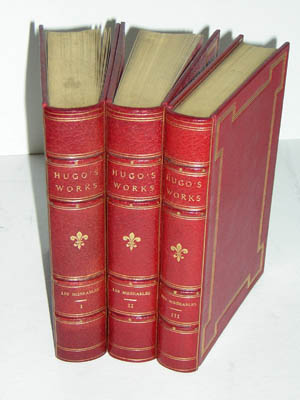
George Barrie & Son, Philadelphia: 1893
Edition Definitive, Number 102 of 1000 copies on Papier de Besancon
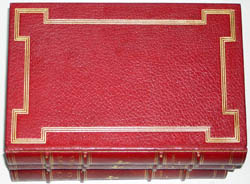
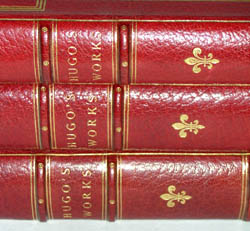
Full red pebbled leather cover, all edges gilt, pink marbleized endpapers
3 volumes, octavo, 7.25 x 5 inches
Sold, please inquire as to the availability of similar items.

Les Miserables by Victory Hugo
Limited Edition 3-Volume Set
Limited Edition 3-Volume Set
This item is sold. It has been placed here in our online archives as a service for researchers and collectors.
- Please inquire as to the availability of similar items currently in stock, or use the navigation bar above to browse our site for currently available items.
- Find guidelines for the use of images from georgeglazer.com.
- To see more archived items, view our directory.
- Find information about selling your art and antiques.
 |
 |
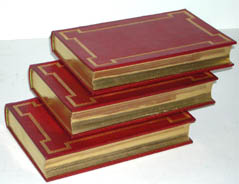 |
Attractively bound three-volume set of the epic novel Les Misérables in English, covered in full red pebbled leather, with gilt fleur de lis on the spines and geometric designs on the covers. This is a numbered copy of a limited edition of 1000.
The novel Les Misérables is an epic story of social injustice and personal redemption, following the fortunes of a Parisian named Jean Valjean, sentenced to prison for 19 years for stealing a loaf of bread. After his release, Valjean forfeits his parole by committing a minor crime, and thereafter is haunted by the police inspector Javert. Valjean eventually reforms and begins a new life as Monsieur Madeleine, a successful businessman and mayor of a northern town. To save an innocent man, Valjean gives himself up and is once again jailed, this time in Toulon . He escapes and adopts the illegitimate child of a poor woman. She grows up and falls in love with a man, who is wounded during a revolutionary fight. Valjean rescues Marius by means of a flight through the sewers of Paris . The young couple marries and Valjean reveals his past. Les Misérables has been reinterpreted in movies and a musical version that opened in Paris in 1980, then translated into English; a successful Broadway production opened in 1987.
Victor Hugo was one of the most important of the French Romantic writers, a novelist, poet, and dramatist, who was also deeply involved in the tumultuous politics of mid-19th-century France . Educated in Paris , he began his writing career in his early 20s with a collection of poems that gained him a royal pension from Louis XVIII. He published his first novel in 1823. The Hunchback of Notre Dame (1831), a historical novel, became an instant success and has gained a lasting place in Western popular culture. Like many of his works, it tells the story of people on the margins of society, a gypsy girl and the deformed bell ringer who loves her. Hugo continued to publish several volumes of lyric poetry during the 1830s. He was elected in 1841 to the Académie Française. After the death of his daughter in 1843, Hugo took a decade-long hiatus from writing. He was involved in politics as a supporter of the republican form of government and social justice, and was elected to the Constitutional Assembly and the Legislative Assembly after the 1848 revolution. Following the 1851 coup d'état by Napoleon III, Hugo believed his life was in danger. He lived in partly voluntary exile for 20 years in Brussels , then Britain . During this time he wrote some his best works, including Les Misérables (1862). During the tumultuous period following the proclamation of the Third Republic , Hugo returned to France , left again for Brussels, was expelled for sheltering defeated revolutionaries, lived as a refugee in Luxemburg, eventually returning to Paris where he was elected senator. Upon his death he was honored with a national funeral attended by two million people, and buried in the Panthéon.
Reference:
"Victor Hugo." The Literature Network. 2004. http://www.online-literature.com/victor_hugo (11 June 2004).