Guy de Maupassant (1850-1893) (author)
Fort Comme la Mort [Strong as Death]
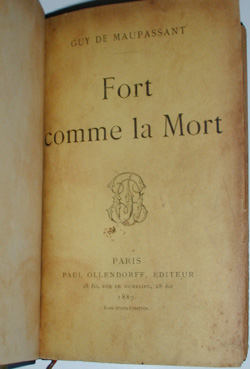
Paul Ollendorff (editeur), 28 bis, Rue de Richelieu, Paris: 1889 (1 st ed.)
Octavo, 7.5 x 4.75 inches
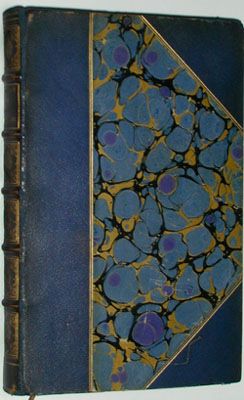
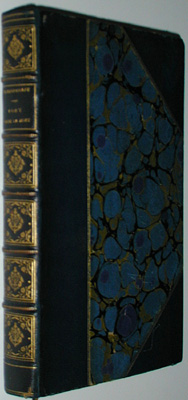
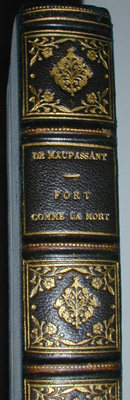
Half blue morocco, marbleized gilt boards, richly gilt decorative spine
Autographed by author: "A Baude de Mauraley, bien Cordialement, Guy de Maupassant."
Provenance: Estate of Grace B. Chambers
Sold--please inquire as to the availability of similar items.

Fort Comme la Mort
Signed Edition by Guy de Maupassant
Signed Edition by Guy de Maupassant
This item is sold. It has been placed here in our online archives as a service for researchers and collectors.
- Please inquire as to the availability of similar items currently in stock, or use the navigation bar above to browse our site for currently available items.
- Find guidelines for the use of images from georgeglazer.com.
- To see more archived items, view our directory.
- Find information about selling your art and antiques.
 |
 |
 |
 |
 |
 |
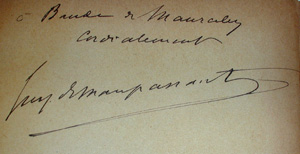
First edition presentation copy of Fort Comme la Mort, autographed and inscribed by the author on the half-title: "A Baude de Mauraley, bien Cordialement, Guy de Maupassant." The hero of Fort Comme la Mort, Maupassant's fifth novel, is Olivier Bertin, a painter in artistic decline and at a romantic crossroads, struggling to both recapture his creative momentum and to choose between two women, a countess and her daughter, who reminds him of the countess in her youth. The title comes from a Biblical saying that love is "as strong as death." The novel explores the mysterious -- and for the protagonist tragic -- interaction of love and creativity.
Guy de Maupassant was a French author of the naturalistic school, considered today the greatest French short story writer. As a young man, he cut short the study of law to volunteer for the French army during the Franco-Prussian War. He spent most of his twenties as a civil servant in the ministries of maritime affairs and education, making his debut as a writer in 1880 with a book of poems and an anthology of stories. During the rest of the decade he wrote six novels, about 300 short stories, three travel books and a book of poetry. His stories explored the hidden psychological dimensions of people beneath the surface of everyday life. His subjects were derived from peasant life in his native Normandy , the Franco-Prussian War, and the mores of the bourgeoisie and fashionable Parisians. Maupassant struggled for many years with mental illness caused by syphilis, which he had contracted during his twenties. He was committed to an asylum in 1892 and died the following year. His style is aligned with that of Flaubert in its directness and objectivity, and his works, especially his short stories, influenced European literature and are still in print, in French and in translation, today.
Reference:
"Guy de Maupassant." The Literature Network. http://www.online-literature.com/maupassant (24 February 2004).