
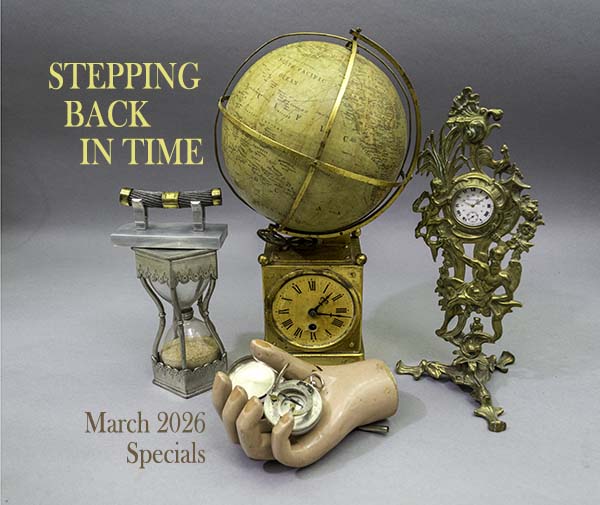
In this issue: In this issue, we step back in time with a fantastic selection of antiques and period works on paper, some of which are literally used to tell time. Bring them into your home to enrich every minute of your day, well into the future.
Contact us for further assistance and gift selection ideas relating to any profession or pastime. Availability of items below subject to prior sale. You can also view them on our website.
Each item is also specially curated for perfect gift giving for the early Holiday shopper.
Contact us for further assistance and gift selection ideas.
As featured in our latest eNewsletters — subscribe now.
Availability of items below subject to prior sale.
Sale prices in effect through April 20, 2026.
TURN BACK THE HANDS OF TIME
DOWN TO EARTH
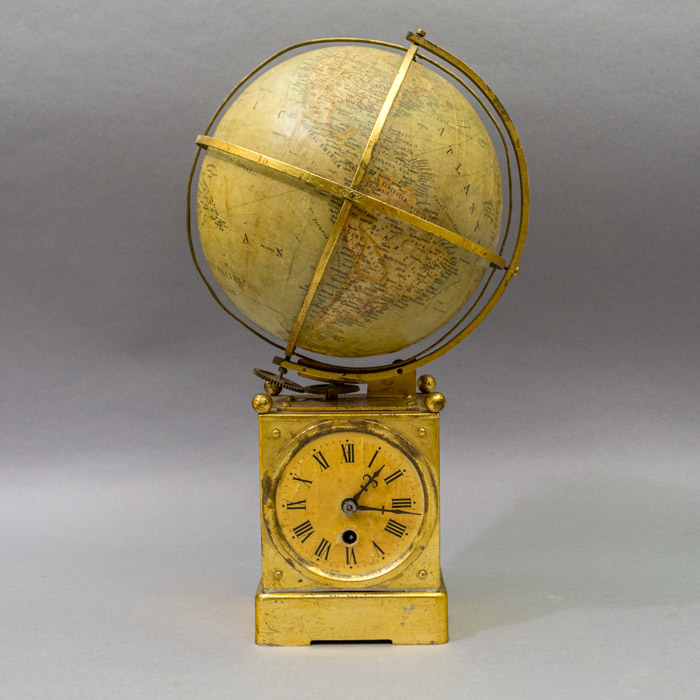
Globes naturally tell time based on the 24-hour rotation of the Earth each day. In this globe clock (European for the American Market, c. 1900), the terrestrial globe is mounted on top of a rectangular gilt metal clock case. The inner clockworks turn the globe once a day as they record time on the clock face. Local time for any place in the world can be determined with reference to the equatorial hour ring that encircles the globe. For our e-news globe collectors, the price is reduced from $3,750 to $3,250. More information.
VISUALLY STRIKING
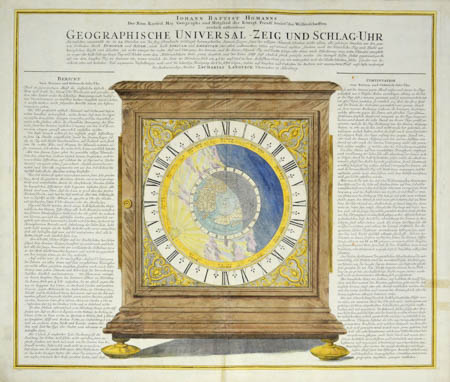
Johann Baptist Homann's Newly Created Universal Geographical Striking Clock Nuremberg is an antique, hand-colored engraving. The clock was designed by the “deservedly renowned” clockmaker Zacharias Landteck to show the time in different parts of the world. At the center of the dial is a polar projection of the northern hemisphere according to the geography of the day. California is shown as an island, as is typical for maps from the first half of the 18th century. Regularly $2,100, now available for $1,800. More information.

WATCH IT!
Our elaborate cast brass rococo revival watch hutch (stand), 19th century, will make an excellent display for your prized family heirloom pocket watch. The decorative piece incorporates four symbolic figures in an elaborate over-the-top rococo design: A rooster represents morning and the rising sun, and an owl represents night as its nocturnal counterpart. A cherub represents the beginning of life and the guardian of hours, and its counterpart father time represents the end — harvest or death. It is shown above with a “Chronometre” Swiss-made pocket watch, sold separately. Priced at $900, discounted to $800. More information.

SINE SOLE SILEO — "WITHOUT THE SUN, I FALL SILENT"
Our equinoctial sundial—German for the English market, 19th century—is housed in a hinged, circular “hunter's” case with a loop at the outer top for attaching to a watch chain, overall resembling a pocket watch. This intriguing scientific instrument is designed to read the correct solar time during daylight hours regardless of the user's location, provided that the latitude is known. Historically, portable sundials of this type were essential tools for merchants, navigators, and wealthy gentlemen during the 18th and 19th centuries. Regularly $2,800; special price here $2,500. More information.

ON THE OTHER HAND
ur mechanical medical split-hook prosthetic flesh-tone hand features a moveable thumb that is voluntarily triggered open or closed by a cord cable. It is engineered in the manner of the famous Hüfner Hand, developed in Germany in the early 20th century, and subsequently manufactured in the second quarter of the 20th century by prominent companies such as the Dorrance Artificial Limb Company. A custom display stand can be designed at an additional cost. Regularly $1,800, sale price $1,500. More information.
WE HAVE ALL THE TIME IN THE WORLD
LIKE SANDS THROUGH THE HOURGLASS, SO ARE THE DAYS OF OUR LIVES
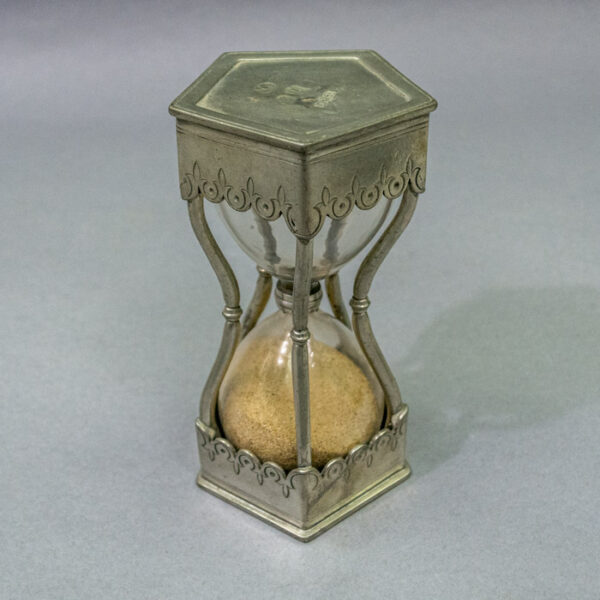
Pewter hourglass—a physical time-keeping instrument of traditional form—features pentagonal ends with incised decoration and makers' hallmarks. Also known as sandglasses, these were critical maritime navigation tools used to measure time intervals for tracking a ship's speed, defining duty shifts, and calculating distance traveled via dead reckoning, long before the advent of reliable mechanical clocks. Regularly $700, specially priced in this e-newsletter for $600. More information.
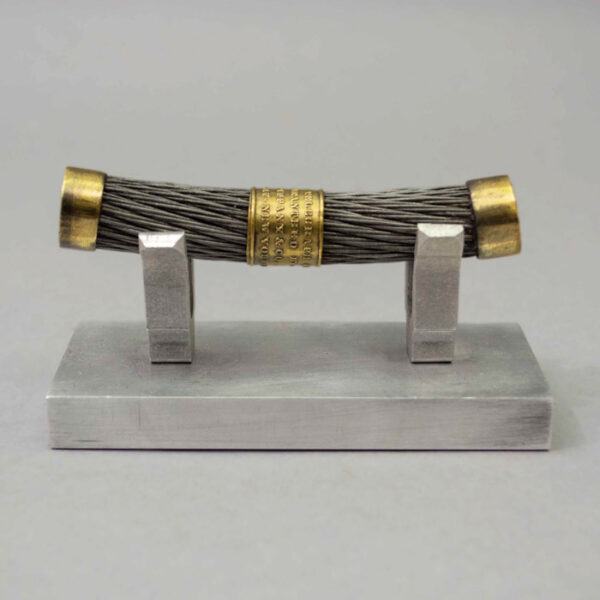
TWO WEEKS TO TWO MINUTES
This slogan captured how the first transatlantic telegraph cable collapsed the amount of time for a message to travel across the Atlantic, reducing it from the weeks it took a ship to sail to just minutes for a telegraph signal. We offer a 4-inch section of the cable as successfully laid between Ireland and Newfoundland in 1858. It operated for a short period of time but broke after a few weeks. Cyrus Field, the visionary financier and promoter who spearheaded the ambitious, years-long effort sold remnants of the 1858 cable to Tiffany & Co., who in turn made them into 4-inch souvenirs. Tiffany added a brass label with their name as seller, and their guarantee of authenticity. The extant Tiffany specimen shown above, in fine condition, is priced $2,200. Stand sold separately. More information.
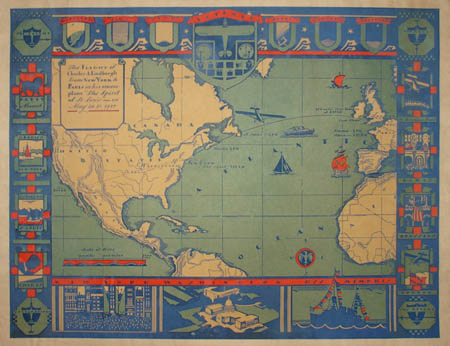
NONSTOP IN RECORD TIME
Charles Lindbergh's historic, epic 1926 nonstop solo transatlantic flight in “The Spirit of St. Louis” from New York to Paris took 33 hours and 30 minutes. This historic milestone is illustrated in a rare Art Deco pictorial map by Amy Drevenstedt. The upper border illustrates the elements he braved: “Distance, Fog, Snow, Sleet, Darkness and Solitude”. Regularly $3,000, now available for $2,550. More information.
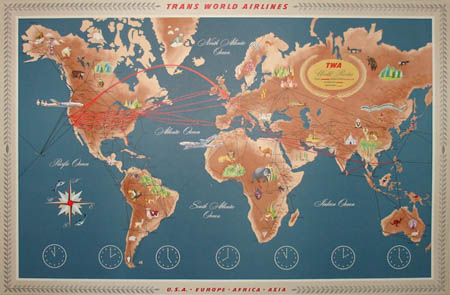
YOU'LL ARRIVE IN NO TIME
This 1950s TWA pictorial map of the world was issued to promote the company’s Direct Polar Route, shown on the map as a thick red line. This flight path—from San Francisco to Paris—was designed to take advantage of the curvature of the Earth, thus cutting the overall time of travel. Website price of $950 lowered to $850. More information.
SINCE THE DAWN OF TIME
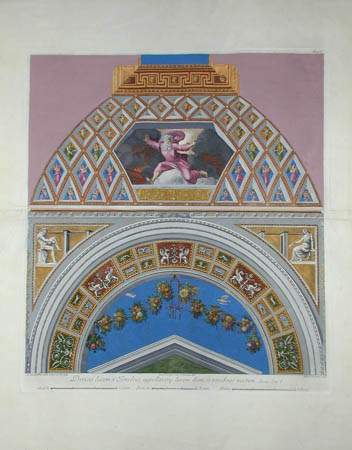
IT'S THE DIFFERENCE BETWEEN NIGHT AND DAY
Raphael’s depiction of the Division of Light and Darkness in the Loggia of the Vatican (often referred to as the Raphael Bible) represents the very beginning of time and creation, establishing the first 24-hour cycle of day and night. This fresco is illustrated in a brilliantly colored 18th-century engraving from Loggia of Raphael in the Vatican, Rome, 1770s. Regularly $1,800, sale price $1,500. More information.
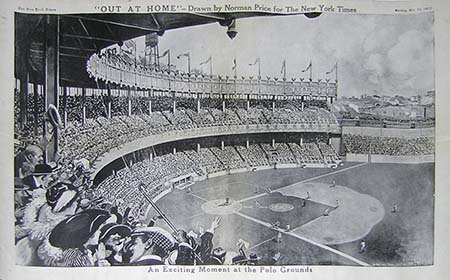
WHEN GIANTS ROAM THE EARTH
Spring training for baseball is in full swing. Opening day of the 2026 MLB season begins at night on March 25 when the San Francisco Giants host the Yankees. Travel back in time to the New York Giants baseball team in Out at Home, An Exciting Moment at the Polo Grounds, a large print from 1912. In this stadium-wide view—from the perspective of fans high in the stands—a runner is shown being tagged out at home. The fourth Polo Grounds, between West 157th and 159th Streets in Manhattan, opened June 18, 1911, and was demolished on April 10, 1964. This large print is on sale for $1,300. More information.
TIME AND TIDE WAIT FOR NO MAN
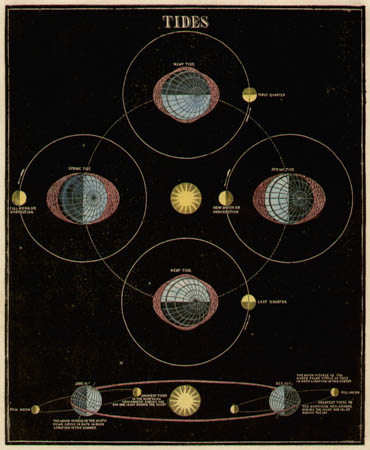
MANY MOONS AGO
Various aspects of Tides are shown in a hand-colored Victorian astronomy print by Asa Smith. These include how the alignment of the Sun and Moon results in higher "spring" tides or lower "neap" tides. The various phases of the Moon as it revolves around the Earth correlate to the changing tidal cycles. Numerous other prints from the series showing other aspects of astronomy, with a particular focus on the solar system, are available as shown here. Usually $325 each, now $250 each. More information.
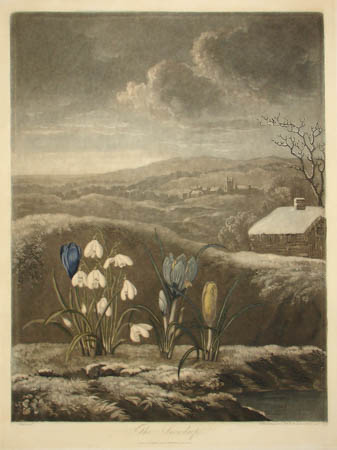
SPRING HAS SPRUNG
It’s almost springtime. That means it is time for the snowdrop—frequently the first outdoor plant to flower after winter—to emerge. In this hand-colored mezzotint from Dr. Robert John Thornton’s Temple of Flora—the greatest British botanical set ever produced—this plant is shown poking out of a hilly rural landscape covered with frost. The composition also includes blooming colorful crocus plants, which are also early harbingers of spring. Indeed, as of March 19th, the date of this enewsletter, the snowdrops and crocuses are already out in the Shakespeare Garden in Central Park! Originally $1,400, but now $1,200. More information.