Henry L. Bryant (1812-1881)
Celestial Indicator
Hartford, Connecticut: 1872
18 1/2 inches high
11 1/2 inches diameter
7 1/2 inch diameter base
Sold, please inquire as to the availability of similar items.

Celestial Indicator
Henry Bryant, 19th Century
Henry Bryant, 19th Century
This item is sold. It has been placed here in our online archives as a service for researchers and collectors.
- Please inquire as to the availability of similar items currently in stock, or use the navigation bar above to browse our site for currently available items.
- Find guidelines for the use of images from georgeglazer.com.
- To see more archived items, view our directory.
- Find information about selling your art and antiques.
 |
 |
 |
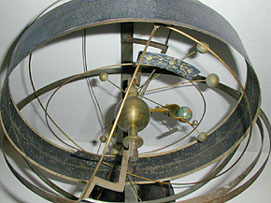 |
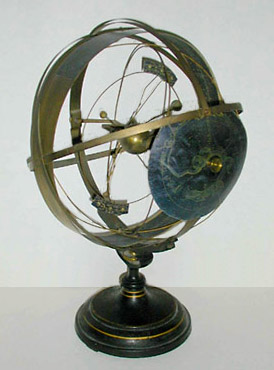
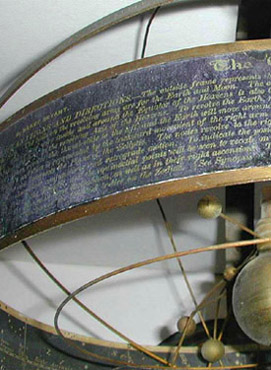
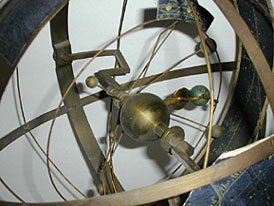
The celestial indicator comprised of a series of calibrated brass armillary bands forming a spherical frame, surrounding an orrery mechanism comprised of the various known planets represented by wooden spheres on wire armatures, spherical and painted wooden representation of the earth with revolving moon sphere, a rectangular plate representing the asteroid belt, and at the very center a brass sphere representing the sun, turning by a knob on the outer part of the sphere. The brass bands mounted with instruction label, label showing the stars in the zodiac belt, and central front label on rounded plate showing the northern sky including the serpent constellation. All raised on a round cast iron base with gilt-line decoration.
The celestial indicator is a unique American two-in-one device, combining an armillary sphere (rings showing the celestial circles of the earth and sky), and an orrery, showing relative planetary movement in the solar system.
It is one of the most interesting and sophisticated American globe/planetary devices ever invented, and should be included in any comprehensive collection of American globes. The device was the invention of Henry L. Bryant, of Hartford, Connecticut.
It is described by Smithsonian globe scholar Deborah Jean Warner as follows:
An artist of Hartford, some of whose work can be seen at the Connecticut Historical Society, Bryant obtained a patent (#131,148) for a celestial indicator in 1872. Essentially a planetarium within an armillary sphere, this demonstrated such astronomical phenomena as the orbital motion of the planets, precession, and nutation.
See also similar examples in National Museum of American History, Smithsonian Institute; Connecticut Historical Society.
Signed on Outer Label: "The Celestial Indicator By HENRY BRYANT HARTFORD, CONN. Explanations and Directions ... Patented Sept. 10, 1872."
References:
Bryant, Henry. A Synopsis of the Elements of Astornomy, and a Description of the Celestial Indicator Hartford: 1872.
1872-1873 Illustrated Catalogue of School Merchandise. J.L. Hammett, Manufacturer, Publisher, Bookseller, Boston: 1872-1873, p. 74.
Groce, George and David Wallace. Dictionary of Artists in America, 1564-1860 New Haven: 1957.