W & T.M. Bardin (globe maker)
W. & S. Jones (seller)
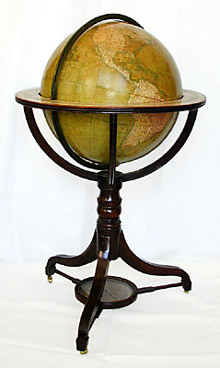
18-Inch Terrestrial and Celestial Floor Globes
Mahogany tripod stands
London: c. 1800-07
40.5 inches high, 24 inches diameter overall
Sold, please inquire as to the availability of similar items.

Pair of Bardin Floor Globes
Early 19th Century
Early 19th Century
This item is sold. It has been placed here in our online archives as a service for researchers and collectors.
- Please inquire as to the availability of similar items currently in stock, or use the navigation bar above to browse our site for currently available items.
- Find guidelines for the use of images from georgeglazer.com.
- To see more archived items, view our directory.
- Find information about selling your art and antiques.
 |
  |
 |
 |
  |
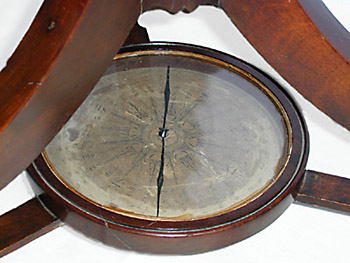
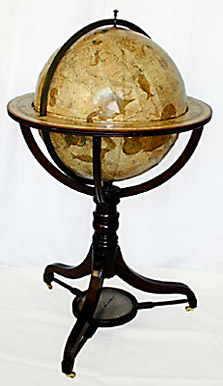
Two globes, one terrestrial showing the world, one celestial showing the constellations. Each surmounted by brass hour disc at North Pole, in full graduated brass meridian, the horizon edged in red paint with hand-colored engraved paper ring showing degrees of amplitude and azimuth, compass directions, days and months of the year, names and engraved figures of the signs of the zodiac, and an equation of time; supported by four quadrants, raised on a mahogany tripod stand with central turned baluster standard, the splayed inswept George III legs joined by compass stretcher with glazed round wooden compass case enclosing a paper compass card and magnetized metal needle; ending in brass casters.
This pair of globes dates from the early 19th Century, the terrestrial dated 1807 (with additions), and the celestial dated 1800. It is common for pairs of globes to have slight variations in year of manufacture, inasmuch as they were updated at different times.
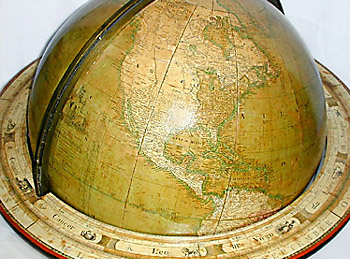
The terrestrial globe comprised of two sets of twelve hand colored engraved gores laid to the ecliptic poles, the equatorial graduated in degrees and hours in both directions, the meridian of Greenwich ungraduated, the equinoctial colure graduated in degrees, the ecliptic graduated in days of the houses of the zodiac, the oceans with an analemma, trade winds, and the numerous tracks of Captain Cook's voyages with dates. Oceans colored olive. Geographical entities cream or olive shaded, with green outline.
The cartography of the terrestrial globe is based on the work of the famous map maker John Arrowsmith. The United States is colored to its contemporary border at the Mississippi River with "LOUISIANA" labeled, and with many native American tribes indicated such as Nachitoches and Osages. Antarctica not indicated, though the South Pole region contains inscriptions such as "many Islands & Fields of Broken Ice" and "Islands of Ice Innumerable."
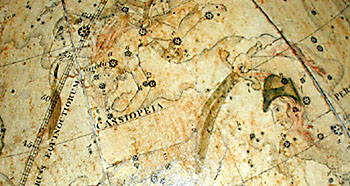
The celestial globe comprised of two sets of twelve hand-colored engraved gores laid to the ecliptic poles, the axis through the celestial poles, the equatorial graduated in degrees and hours, the colures graduated in degrees, the ecliptic graduated in days of the houses of the zodiac with twilight zone, constellations elegantly depicted by figures of mythical beasts and scientific instruments, the stars shown in a chart to nine orders of magnitude, together with planetary nebulae, nebulae and clusters, the poles printed with an hour dial. Cream colored background, the constellations in tones of pink, grey, and olive.
For more information on the Bardin Family, please see our Guide to Globe Makers.
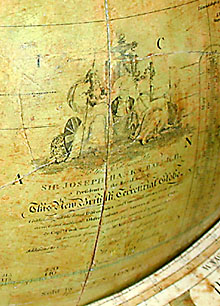
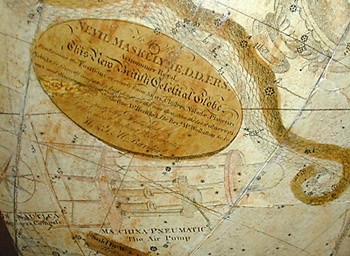
Bardin family 18-inch New British Globes generally include dedications to the scientist Sir Joseph Banks (1743-1820), President of the Royal Society (terrestrial) and astronomer Neville Maskelyne (celestial). Banks was a key figure in British science and government and in the development of the British colony in New South Wales. He remains the longest serving president of the Royal Society, and held a number of government roles. The Reverend Nevil Maskelyne (1732-1811) was appointed Royal Astronomer in 1765. Among his achievements were the British Mariner's Guide of 1763, the invention of the prismatic micrometer, making the first calculations of the Earth's mass in 1775 based on Newton's theories, and the rectorships of Shrawardine, Salop and North Runcton, Norfolk.
These present pair of globes were sold by the scientific instrument makers and dealers W. & S. Jones, as is frequently so with Bardin globes. Sir William Jones (1763-1831), an optician and instrument maker later formed a partnership with his younger brother Samuel Jones. W. & S. Jones were among the greatest scientific instrument makers in London during the late 18th and early 19th centuries. W. & S. Jones published The Description and Use of a New Portable Orrery to promote their instruments and to describe their use.
These globes have an impressive American provenance. They were owned by Walter Evans Edge (1873-1956), who bequeathed them to his son; later they were sold by his son's estate. The elder Edge served as the governor of New Jersey and ambassador to France between World War I and II. He was involved with the establishment of the U.S. Bureau of Budget and General Accounting Office and the Port Authority of New York, the repeal of the 18th Amendment, and construction of the Holland Tunnel. A similar pair of globes (also with terrestrial additions to 1807) are in the Museum of the History of Science, Oxford.
Terrestrial Cartouche : To the Rt. Honorable/ SIR JOSEPH BANKS BAR. K. B. / President of the Royal Society/ This New British Terrestrial Globe/ Containing all the latest Discoveries and Communications, from the most / correct and authentic Observations and Surveys, to the year 1799/ by Captn. Cook and more recent Navigators. Engraved from/ an accurate Drawing by Mr. Arrowsmith, Geographer/ Additions to 1807 / Respectfully Dedicated / by his most obedient hble. Servants / W. & T.M. Bardin/ Sold by W.& S. Jones/ Holborn, London
Celestial Cartouche: To the Rev. / NEVILLE MASKELYNE, D.D., F.R.S./ Astronomer Royal/ This New British Celestial Globe /Containing the Positions of nearly 6000 Stars, Clusters, Nebulae, Planetary Nebulae &c., Correctly computed & laid down for the year 1800 : from the latest observati-/ons and discoveries by Maskelyne, Dr. Herschel, The Revd. Mr. Wollaston &c. &c./ respectfully Dedicated/ by his most obedient hble. Servants, / W. & T.M. Bardin
Inset Rectangular Label on Celestial Globe: Sold by W. & S. JONES/ Holborn London
References:
Chambers Biographical Dictionary. Edinburgh: 1990.
Dekker, Elly. Globes At Greenwich. Oxford: 1999.
Dekker, Elly and Peter van der Krogt. Globes From The Western World. London: 1993.
Millburn, J.R. and T.E. Rössaak, "The Bardin Family, Globe-Makers in London, and Their Associate, Gabriel Wright," in Der Globusfreund, No. 40/41 (1992), pp. 21-57.