Jacques Eustache de Sève (fl. 1742-1788) (after)
Georges-Louis Marie Leclerc, Comte de Buffon (1707-1788) (editor)
C. Baron, N. du Four, L. Le Grand, Cath. Haussard, C. Guttenberg et al. (engravers)
Pair of Owls: Le Grand Duc & L’Effraie
from Histoire Naturelle, générale et particulière, avec la description du Cabinet du Roi [Natural History, General and Specific, with the Description of the Office of the King]
De L'Imprimerie Royale, Paris: 1749-1804
Hand-colored engravings
10 x 7.75 inches overall, approximately
8.25 x 6.5 inches, plate mark, approximately
Sold, please inquire as to the availability of similar items.

Pair of Owls at Night
Buffon 18th Century Prints
Buffon 18th Century Prints
This item is sold. It has been placed here in our online archives as a service for researchers and collectors.
- Please inquire as to the availability of similar items currently in stock, or use the navigation bar above to browse our site for currently available items.
- Find guidelines for the use of images from georgeglazer.com.
- To see more archived items, view our directory.
- Find information about selling your art and antiques.
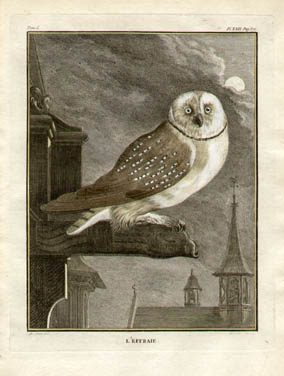 Le Effraie |
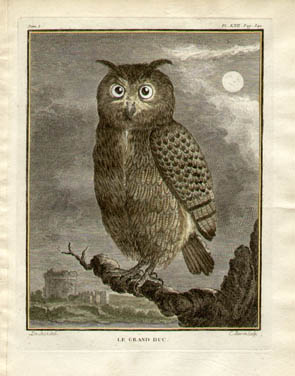 Le Grand Duc |
Pair of prints of owls, each shown in the night sky with full moon. Le Grand Duc is on a branch with ancient ruins in the background, and L’Effraie is on a downspout in a city, with a steeple in the background.
Georges-Louis Marie Leclerc, the Count of Buffon, was a French aristocrat of formidable intellect and achievements, including books on mathematics and natural history. Although his father initially steered him toward law school, Buffon persisted in pursuing his interest in math. At the age of 20, he discovered the binomial theorem and later introduced differential and integral calculus into probability theory. He soon became fascinated with biological science, and his father relented and let him enroll in the faculty of medicine to study botany and zoology. As a young man in Paris, he befriended Voltaire and other intellectuals, and gained admission to the prestigious Academy of Science at age 27.
Buffon’s Histoire Naturelle was his major achievement and an ambitious project characteristic of the 18th-century Enlightenment: a 44-volume encyclopedia attempting to include everything known about the natural world and widely disseminate scientific knowledge. It was the first complete natural history survey presented in a popular form, and also broke ground in attempting to separate science from theological dogma. Decades before Darwin introduced his theory of evolution, Buffon dared to challenge religious thought with empirical observations, suggesting that the earth was older than 6,000 years and that the physical resemblance between humans and apes might be explained by their having a common ancestry. While the theories he proposed to explain these phenomena were by and large incorrect, he correctly grasped that a new paradigm was needed.
Jacques Eustache de Sève was the principal artist commissioned by Georges Buffon for his Histoire Naturelle between 1749 and 1760, and also produced the illustrations for a work called Encyclopedie Methodique (1774-1832). Rather than isolating the animals on the page, his illustrations were complete scenes including classical landscape backgrounds, which influenced later natural history illustrators.
References:
"Buffon." Info Science Portraits. 1998-2003. http://www.infoscience.fr/histoire/portrait/buffon.html (16 June 2003).
"Georges-Louis Leclerc, Comte de Buffon." UMCP Exhibition Halls: Evolution. http://www.ucmp.berkeley.edu/history/buffon2.html (16 June 2003).
O'Connor, J.J. and Robertson, E.F. "Georges Buffon." School of Mathematics and Statistics, University of St. Andrews, Scotland. 1996. http://www-gap.dcs.st-and.ac.uk/~history/Mathematicians/Buffon.html (16 June 2003).
Peters, Greg. "Jacques E. De Seve." Scientific Illustrator Newsletter. Vol. 1 No. 1. July 2002. http://www.scientificillustrator.com/newsletter/de-seve.html (17 June 2003).