Karl Joseph Brodtmann (1787-1862) (artist and lithographer)
Butterflies and Moths
from
Naturhistorische Bilder Gallerie aus dem Theirreiche
[Natural History Picture Gallery of the Animal Kingdom]
Zürich or Schaffhausen: c. 1830s
Hand-colored lithographs
13 x 11.5 inches, image (approximate)
14 x 17.5 inches, sheet
Sold, please inquire as to the availability of similar items.
To see other Brodtmann natural history prints on our site, use our site search engine.
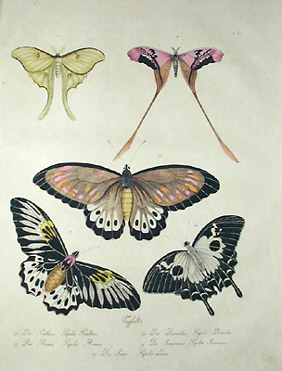
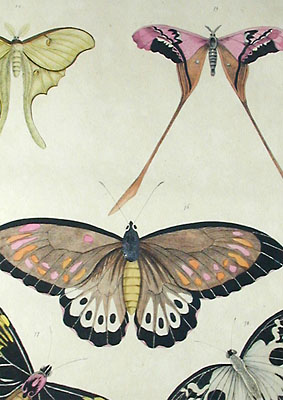
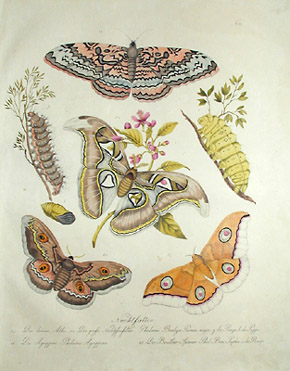
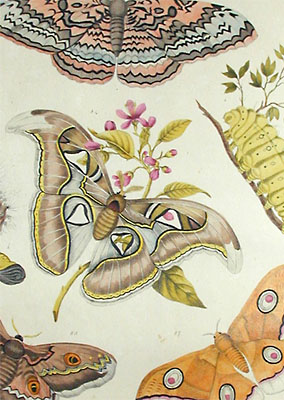
Natural history studies of butterflies and moths. They were produced in the Age of Enlightenment, when various animal species were first classified in accordance with the system developed by Linneaus. Butterflies and other natural specimens were illustrated in hand-colored print sets for biologists, as well as for aristocrats interested in learning about the latest discoveries of flora and fauna. These plates combine scientific accuracy and a sophisticated aesthetic sense, with artistic arrangements of the animals highlighting their natural shapes, colors and decorative patterns.
They are from a series on the animal kingdom, showing a wide variety of species, including elephants, rhinoceroses, lions, monkeys, horses, reptiles, butterflies and insects. Some plates also depict indigenous peoples. These are early examples of educational natural history books about the animal kingdom, a genre which remained popular throughout the 19th century. They are also early examples of lithographic printing, which had been introduced by German inventor Alois Senefelder in the 1790s.
Karl Joseph Brodtmann was one of the most accomplished lithographers of his day, as well as a printseller and bookseller who lived in Zurich and Schaffhausen, Switzerland. His natural history lithographs include Heinrich Rudolf Schinz's natural history volumes on reptiles and birds, published in the early 1830s. Brodtmann also produced the offered folio natural history lithographs, probably also in the 1830s, as Naturhistorische Bilder Gallerie aus dem Theirreiche.
Reference:
Bénézit, E. Dictionnaire critique et documentaire des Peintres, Sculpteurs, Dessinateurs et Graveurs. France: Librairie Gründ, 1966. Vol. 2, p. 146.