

Copyright ©2002-2022 by George D. Glazer. All rights reserved. No part of this document may be reproduced in any form or by any means without written permission of the author.
"Planetaria" is a general term for three-dimensional models of the solar system or of the earth, the moon and the sun. The three major types of planetaria are the tellurian (sometimes called tellurium), the orrery and the armillary sphere. All are discussed and illustrated on the page below. At the bottom of the page are links to transcripts of George Glazer talking with Martha Stewart about planetary models on two different television episodes of Martha Stewart Living in the 1990s.
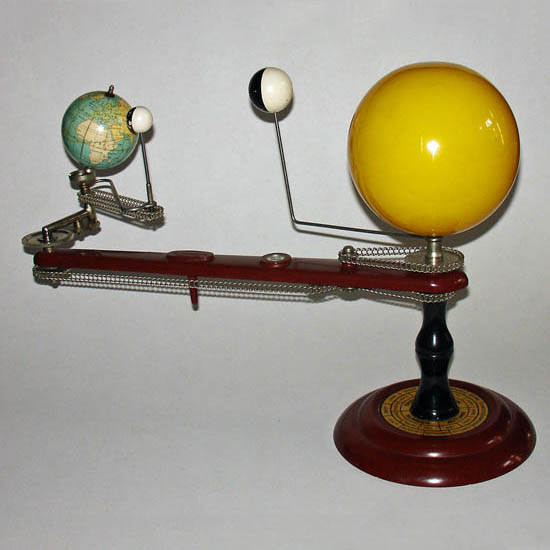


Tellurians (also called telluriums) A tellurian (also called tellurium) is a mechanical astronomical demonstration device used to show seasons, eclipses and other astronomical phenomena relating to these bodies. It is generally
operated by clockwork gears and chains, or string pulleys, and is comprised of a small terrestrial globe turning at the end of an arm, spherical painted wood representations of the moon and the planet Venus, and a central brass or gilt wood sphere representing the sun above the stand. Often a zodiac scale is affixed to the base. When operated, at relative representational rates, the earth spins once a day and revolves around the sun once a year, the moon revolves around the earth once a month, and Venus revolves around the sun. (See video demonstrations below.)
An explanation of an American tellurian in a 19th Century trade catalog provides a good general working definition of this instrument and its purpose:
"The Tellurian, or Season-machine, has been prepared to assist the teacher in explaining the phenomena arising from the revolutions of the earth, and its relations to the other heavenly bodies. It illustrates the causes of
1st. Succession of day and night, and their difference in length.
2d. Changes of the seasons.
3d. Changes of the moon.
4th. Solar and lunar eclipses
5th. Philosophy of tides.
6th. Precession of the equinox.
7th. Differences of solar and sidereal time."

The Trippensee Planetarium is a demonstration model of the movement of the earth, moon and Venus relative to each other and to the sun. It shows such phenomena as the succession of seasons, and solar and lunar eclipses. The original models, patented in 1908, have maple arms and central standards. Those produced around the second quarter of the 20th century have ebonized arms and central standards. Models made after World War II models are of Bakelite or plastic.

Andrews' Tellurian, made around 1900 by Weber Costello, has a terrestrial globe and a black-and-white painted moon at the end of a nickel-plated cast iron arm, operated by a gearwork mechanism under the arm.
Trippensee Tellurian Video Demonstrations
George shows how a Trippensee tellurian illustrates astronomical principles in the three one-minute videos below, originally produced as Instagram reels.
Part 1
Part 2
Part 3
Armillary spheres are generally astronomical demonstration devices or sundials. Typically they have concentric rings to indicate planetary orbits and/or terrestrial and celestial measurement circles, and a zodiac band. We feature a large selection of armillary spheres, both Copernican, with the sun at the center, and Ptolemaic, with the earth at the center. We also feature metal sundial armillary spheres, each generally with a central arrow. Armillaries are made from a variety of materials, including brass, iron, wood, and pasteboard with applied paper calibrations.
A Ptolemaic Armillary Sphere has an earth globe at the center. It is named after Ptolemy, an astronomer of ancient Greece who popularized the geocentric theory of the universe that the sun and planets revolve around the earth. In a Ptolemaic armillary sphere, the central globe is surrounded by an equatorial circle, as well as circles for the tropics of Cancer and Capricorn and the Arctic and Antarctic poles. These in turn are surrounded by a zodiac band, all within a meridian (with which the sphere can be rotated) and a stationary horizon band, on a stand, generally with central baluster and round base. Although the name of the Ptolemaic armillary sphere implies that it shows the geocentric theory of the universe, this device does not include the sun or other planets. In our opinion, it was more likely designed to show the positions of the constellations on the zodiac band relative to the “apparent path” of the sun (the zodiac band is positioned on the ecliptic), and to show the position of the earth relative to the other circles in which it is set.
A Copernican Armillary Sphere has a sun ball at the center. It is named after Nicolas Copernicus who popularized the heliocentric theory of the universe that the sun was the center of the universe, and the planets revolve around it. In a Copernican armillary sphere the central sun is surrounded by a series of concentric rings representing the planets (and sometimes asteroid belts) that revolve around the sun. Generally the earth is shown in an opening in the third circle as a sphere, with a small revolving moon. These planetary circles are surrounded by a zodiac band (set as a flat band at the center), and solstice and equinox circles, on a stand, generally with central baluster and round base. This arrangement resembles an orrery on its side; indeed sometimes Copernican armillary spheres contain an orrery with small round or disc planets on rod arms that are moved by hand.
A Sundial Armillary Sphere is made for a garden to tell time by the shadow made from passage of the sun during the day. It is like a simple form Ptolemaic armillary sphere, but with central arrow rather than earth sphere. The zodiac band is calibrated on the inside with daylight hours, and the arrow serves as a sundial gnomon to cast a shadow on the zodiac band to indicate time. The whole is set within equatorial and meridian circles and raised on a stand, often of an atlas figure supporting the sphere. Other stands include a zodiac pyramid, seahorse, baluster, etc. Sundial armillaries were generally intended for garden use and designed so that the base can be bolted into a larger heavy support, such as a columnar garden pedestal. Exterior examples are often used for interior use with a smaller decorative base. Indeed, some sundial armillaries are not weather-proof for garden use; they were intended solely for interior use as decorative objects.

A Ptolemaic armillary sphere has an earth globe at the center, surrounded by celestial circle and zodiac armillary rings, demonstrating the geocentric theory of the universe developed by Ptolemy and others in ancient Greece and Rome. This one was made in Paris in 1753 by Louis-Charles Desnos.

A Copernican armillary sphere has a sun ball at the center, with planetary and zodiac armillary rings, demonstrating the modern theory of the solar system, first popularized by Nicolaus Copernicus during the Renaissance. This 19th-century French armillary also has an orrery mounted inside.

Orreries are mechanical astronomical demonstration devices used to shown the relative sizes and motions of the known planets in the solar system. It is generally operated by clockwork gears, and is comprised of spheres on wire armatures representing the planets (and their moons) that turn at relative representational rates around the central brass or gilt wood sphere representing the sun, above the stand.
An explanation of an American orrery in a 19th Century trade catalog provides a good general working definition of this instrument and its purpose:
"The Orrery is an instrument which shows the proportional size and relative position of the planets, and times of their revolution. An illustration with this machine brings out our vast system of sun, planets, and moon, into perfect and tangible shape, and in so small a compass that the young, even, can comprehend it."
Restoring Old Planetaria
The Trippensee Company used to sell replacement parts for planetaria, including their older H and S models. They since have been taken over by Science First. For more information, contact them.
Learn More
• Collecting Tellurians & Orreries: Transcript of Q & A from George's 2002 appearance on the Martha Stewart Living TV show.
• Collecting Celestial Globes & Maps: Q & A from George's 2001 appearance on the Martha Stewart Living TV Show.
• The Art of Collecting: Our online articles on collecting.
Copyright ©2002-2022 by George D. Glazer. All rights reserved. No part of this document may be reproduced in any form or by any means without written permission of the author.