Gilman Joslin/Josiah Loring
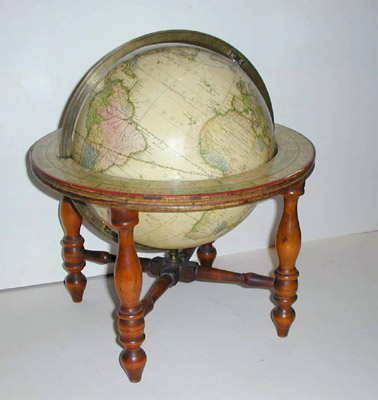
9 1/2-Inch Terrestrial Table Globe
Boston: 1869
15 inches high, 13 inches diameter
Sold, please inquire as to the availability of similar items.

9 1/2-Inch Table Globe
Gilman Joslin and Josiah Loring, 19th Century
Gilman Joslin and Josiah Loring, 19th Century
This item is sold. It has been placed here in our online archives as a service for researchers and collectors.
- Please inquire as to the availability of similar items currently in stock, or use the navigation bar above to browse our site for currently available items.
- Find guidelines for the use of images from georgeglazer.com.
- To see more archived items, view our directory.
- Find information about selling your art and antiques.
 |
 |
The terrestrial globe surmounted by a brass hour pointer, the North Polar hour calotte printed with hour ring, and having a full brass meridian, within a circular horizon band with engraved paper calendar and zodiac, raised on a turned maple stand with four legs joined by a cross stretcher.
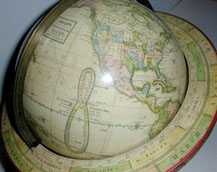
The oceans are cream colored and geographical features have blue, green, pink and yellow shading, with wide green outlining and some thin red outlining. Alaska is shown as "Alaska." States, regions and territories shown west of Mississippi include Texas, California, and "Oregon Ter." Physical geography relating to temperate zones indicated by lines showing Northern and Southern "Limit of Wood," "Limit of Grain," "Limit of the Vine," and "Limit of Bananas." Antarctica not shown, but point near South Pole indicated as "Capt. Weddell R.N. reached this point 1823."
This globe was made by Gilman Joslin (1804-c. 1886), one of America's most prolific globe makers. Read more about him in our Guide to Globe Makers.
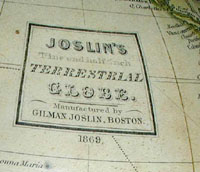
Trapezoidal Cartouche: JOSLIN'S/ Nine and half Inch/ TERRESTRIAL/ GLOBE./ Manufactured by/ GILMAN JOSLIN, BOSTON./ 1869
References:
Dekker, Elly and van der Krogt, Peter. Globes from the Western World. London: Zwemmer, 1993. pp. 126, 140, 176.
How to Use a Globe, Joslin’s Terrestrial and Celestial Globes/ Joslin’s Hand-book to the Terrestrial and Celestial Globes. Gilman Joslin & Son, Manufacturers and Dealers, 5 Mt. Vernon Avenue, Boston, Massachusetts: [n.d., but c. 1890], pp. 3-4.
Warner, Deborah Jean. “The Geography of Heaven and Earth,” Rittenhouse Journal of the American Scientific Instrument Enterprise, Vol. 2, No. 3. 1987. pp. 100-103.
Yonge, Ena L. A Catalogue of Early Globes, Library Series No. 6. American Geographical Society: 1968. pp. 37-38.