A.H. Andrews & Co.
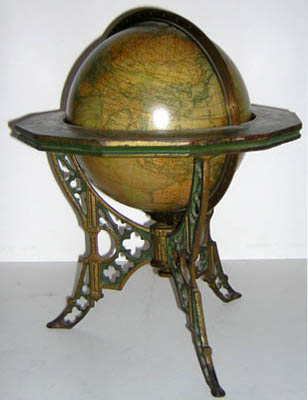
8-Inch Terrestrial Table Globe
Chicago: c. 1880s
Cast-iron stand
15 inches high
Sold, please inquire as to the availability of similar items.

Andrews 8-Inch Terrestrial Globe
Gothic Cast Iron Base
Gothic Cast Iron Base
This item is sold. It has been placed here in our online archives as a service for researchers and collectors.
- Please inquire as to the availability of similar items currently in stock, or use the navigation bar above to browse our site for currently available items.
- Find guidelines for the use of images from georgeglazer.com.
- To see more archived items, view our directory.
- Find information about selling your art and antiques.
 |
 |
 |
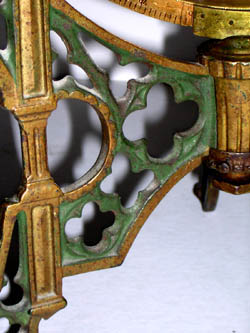 |
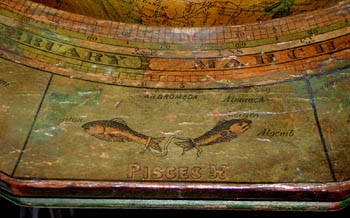
The eight-inch terrestrial globe is surmounted by a simple triangular hour pointer, and has a printed north polar hour calotte, the Andrew's type brass meridian with stationery outer ring and inner moveable ring, and the Andrew's type 12-sided horizon band with engraved paper calendar and zodiac, each side corresponding to a sign of the zodiac with an illustration of it. The globe is raised on a cast-iron pierced tripod stand, the flat shaped supports and legs decorated in the Gothic-Revival taste with cut-out figures of trefoils and quatrefoils, and joined by a central cylinder-form standard with terminal tightening bolt and knob. The stand is subtly decorated with gold and green paint, probably original.
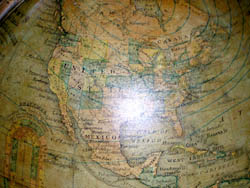
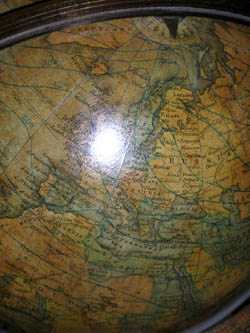
Oceans are green, geographical entities shaded in green and various faded other colors, some geographic entities outlined in green. The Dakotas are named “DAK” as one territory, Oklahoma is shown as “IND TER” (Indian Territory) and Alaska is shown. “South Pass, Longs Pk. and Pikes Peak” are indicated in the Rocky Mountains. The outline of the southeastern point of Nevada extends to a full triangle, and Montana and Idaho are irregularly shaped. Isothermal lines, probably for January, are shown in blue, with associated degree numerals, but not indicated in key. Red isothermal lines are either not present or completely faded. Ocean currents are indicated in white. There is a elongated oval analemma.
This globe is noteworthy for the use of Gothic motifs in the stand, in this case in the form of trefoils and quatrefoils. In America in the second half of the 19th century, there were numerous successive periods of revivals – designs based on traditional styles but with a Victorian interpretation. The use of motifs of the latest Victorian revival style, in this case Gothic Revival, is characteristic of American globes; designers of stands often would utilize the styles of decorative arts movements of the period. Moreover, iron was a favored material of American globe makers for use in stands. By contrast, well into the late 19th century, British globe makers favored mahogany or ebonized wood, and the stands that some of them produced were virtually identical to those of the earlier Georgian period or followed designs that had become popular in the late 18th and early 19th centuries.
The basic form of this globe stand appears to have evolved from the Charles Holbrook three-legged cast iron stand, also with flat legs and supports pierced with decoration, and with the small barrel form standard in the center joining the legs. This form type of stand, modified with Gothic pierced decoration was used extensively by A.H. Andrews, supporting the proposition that this is an Andrews globe with Baker Pratt inset label. The 12-sided horizon band is generally associated with Andrews globes. The gores of the globes bear some resemblance to those of the British globe maker W. & A.K. Johnston, and were possibly imported by Andrews from them.
For information on A.H. Andrews, please see our Guide to Globe Makers.
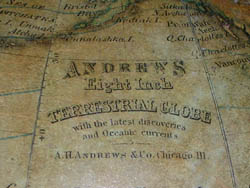
Cartouche: ANDREW’S/ Eight Inch/ Terrestrial Globe,/ With latest discoveries and/ Oceanic Currents/ A.H. ANDREWS & CO. Chicago, Ill.
References:
An Illustrated Catalogue of Improved School Furniture and School Supplies. New York: Baker, Pratt & Co., 19 Bond Street, 1879, p. 42. (Shows one very similar but slightly different quatrefoil decoration.)
Andrews Broadside. (Show one nearly identical but with slightly different quatrefoil decoration.)
How to Use Globes in the School and Family, 16th Ed., Chicago: A.H. Andrews & Company, 215-221 Wabash Avenue, 1888. (Cover illustration very similar but with a slightly different quatrefoil decoration.)