Delamarche et Cie (attributed to)
Copernican
Armillary Sphere with Internal Orrery
Paris: Early 19th Century
Pasteboard, applied engraved paper
20.5 inches high; 12.5 inches diameter overall
Sold, please inquire as to the availability of similar items.

Copernican Armillary Sphere with Orrery
Delamarche & Cie., Early 19th Century
Delamarche & Cie., Early 19th Century
This item is sold. It has been placed here in our online archives as a service for researchers and collectors.
- Please inquire as to the availability of similar items currently in stock, or use the navigation bar above to browse our site for currently available items.
- Find guidelines for the use of images from georgeglazer.com.
- To see more archived items, view our directory.
- Find information about selling your art and antiques.
 |
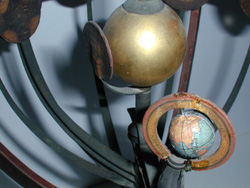 |
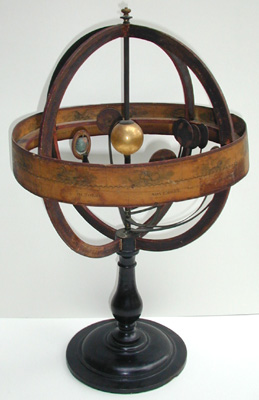
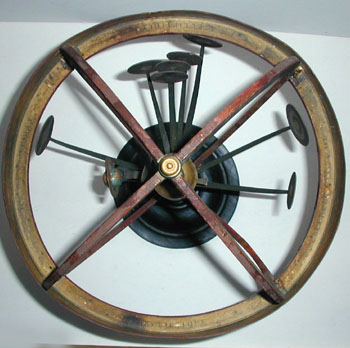
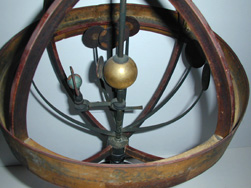
The Copernican armillary sphere with central gilt ball representing the sun, the planetary orbits from Mercury to Saturn represented by curved quadrant metal arms with applied circular engraved discs at the ends, the earth's orbit with metal armature supporting turned wooden ebonized support for painted earth sphere in full meridian, the earth string driven to revolve and surmounted by revolving moon disk; all within full equinox and solstice meridians, the central ecliptic band surrounded by flat horizon band with engraved paper calendar and zodiac printed on both sides; raised on an ebonized stand with central turned standard, and dish base.
Ptolemy (2nd Century A.D), an Alexandrian astronomer believed that the earth was at the center of the universe. In the Renaissance, the Polish astronomer Nicolaus Copernicus (1473-1543), published his important treatise in which he proposed the revolutionary theory that the sun was the center of the universe. This challenged the geocentrism of Ptolemy, and was particularly controversial in the Catholic Church because of its conflict with basic Christian teachings at that time.
In France in the 19th century armillary spheres were made to demonstrate various theories of astronomy. An armillary sphere with the earth at the center is known as Ptolemaic, while an armillary sphere with the sun at the center such as this is known as Copernican. Often Copernican armillary spheres have concentric bands representing the orbits of the various planets. An example such as this, with discs representing the planetary orbits, is sometimes considered a part orrery.
This armillary is characteristic of those produced by Delamarche family of cartographers, the most renowned and prolific producers of globes and armillary spheres in France in the 19th century. For more information see our Guide to Globe Makers.