Joseph Broader (act. 1820s)
A New System of Artificial Memory, Applied to General History, Chronology, etc., Ancient and Modern
J. Richardson, London: 1827
26 (of 27) engravings in bound volume
(plate volume only, no text)
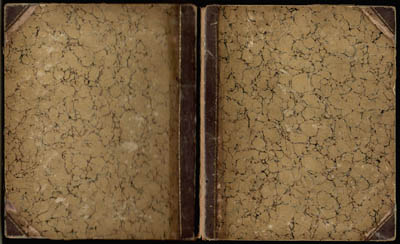
Octavo, marbleized boards,
simple leather spine
8.75 x 7.25 inches
Sold, please inquire as to the availability of similar items.

Joseph Broader Book of 26 Engravings
A New System of Artificial Memory
A New System of Artificial Memory
This item is sold. It has been placed here in our online archives as a service for researchers and collectors.
- Please inquire as to the availability of similar items currently in stock, or use the navigation bar above to browse our site for currently available items.
- Find guidelines for the use of images from georgeglazer.com.
- To see more archived items, view our directory.
- Find information about selling your art and antiques.
 |
 |
 |
 |
 |
 |
 |
 |
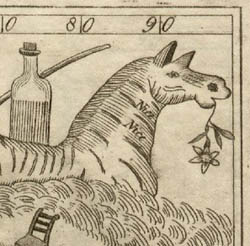 |
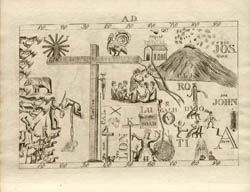
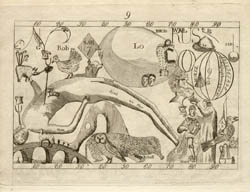
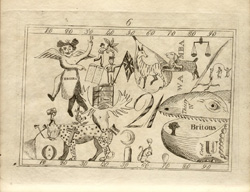
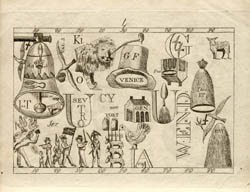
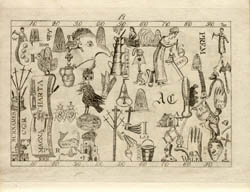
Bound volume of 26 (of 27) unusual engraved prints that symbolically and pictorially portray the history of the world by century, beginning with the 7th century B.C.E. and ending at 1827, the publication date of the book. The plates were intended to serve as a mnemonic device -- a visual aid to assist with recall of historical chronology and important events and dates. Each century is divided into 10 decades (except the 19th century, which is divided into nine 3-year periods up to 1827).
Although the engravings were made well before the Modern era, the graphics resemble Dadaist art from the early 20th century with their floating, naively drawn figures and objects in varied scale; isolated letters and words; and overlapping, collage-like compositions of items that have no obvious relationship.
From the late 18th century through much of the 19th century, there was a movement to incorporate visual representations into education as aids to memorization -- from classroom maps and globes to picture encyclopedias. Broader’s book appears to belong to that movement, although its approach relates specifically to mnemonics – the use of a device, such as a formula, picture or rhyme, as an aid in remembering. Joseph Broader also contributed to an 1825 book summarizing a series of lectures on “the present state of science.” Intriguingly, there is a “Joseph Broader, schoolmaster” listed in an 1822 gazetteer directory for the small town of Settle, 235 miles from London -- perhaps the same person. Meanwhile, a different author, John Henry Todd, also published a book with the same theme in London in 1827, but with straightforward and less imaginative illustrations: Historical Tablets and Medallions Illustrative of an Improved System of Artificial Memory.
This is a rare book. According to the OCLC, a catalog of library records, there are five examples of it in U.S. libraries at Princeton University, Pennsylvania State University, the California State Library, Yale University and the University of Missouri. The complete version has a total of 329 pages. The volume offered here, however, has no text or title page, only the engravings, with 26 of the original 27 plates present; the 6th century (numbered “5”) lacking.
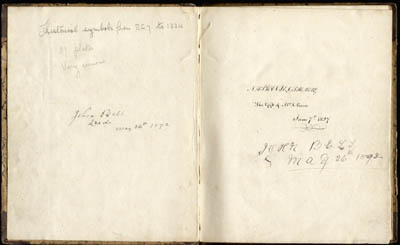
Provenance: Nathaniel Sharpe, calligraphic inscription ("The Gift of Mr. S. Swire June 7th 1827"); Frederic Walker Joy, Oriel College, Oxford, armorial bookplate; John Bell, inscription dated Leeds, 26 May 1892.
References:
“A new system of artificial memory...” OCLC FirstSearch Detailed Record. http://firstsearch.oclc.org/ (18 May 2006).
“IoP Journal Abstracts 1-25.” PSIgate Physical Sciences Information Gateway. http://www.psigate.ac.uk/roads/cgi-bin/searchpublishers.pl?term1=X-ray+astronomy (19 May 2006).
“Transcript of the entry of ‘professions and trades’ for Giggleswick in Baines's Directory and Gazetteer Directory of 1822.” Genuki. 27 July 2005. http://www.genuki.org.uk/big/eng/YKS/WRY/Giggleswick/Giggleswick22Dry.html (19 May 2006).