Josef Kuwasseg (1799-1859) (after)
Leopold Rottmann (1812-81) (lithographer)
Illustrations of Plant and Animal Development in Prehistoric Periods
from Die Urwelt in ihren verschiedenen Bildungsperioden
[The Primeval World in Various Developmental Periods]
S. Minsinger and A. Geisberger, Munich: c. 1851
Lithographs with later hand color
12.25 x 17.5 inches, image
13.25 x 18.75 inches, decorative border
19 x 24 inches, overall
Sold, please inquire as to the availability of similar items.

Illustrations of Plant and Animal Development in Prehistoric Periods
Set of 14 Folio Lithographs, Munich: c. 1851
Set of 14 Folio Lithographs, Munich: c. 1851
This item is sold. It has been placed here in our online archives as a service for researchers and collectors.
- Please inquire as to the availability of similar items currently in stock, or use the navigation bar above to browse our site for currently available items.
- Find guidelines for the use of images from georgeglazer.com.
- To see more archived items, view our directory.
- Find information about selling your art and antiques.
{title}
Translation: {translation}
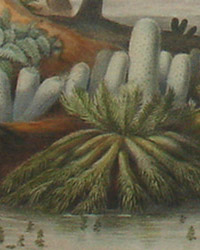
Detail of Plate 1 |
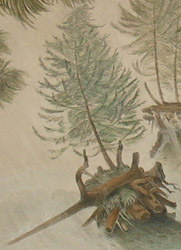
Detail of Plate 2 |
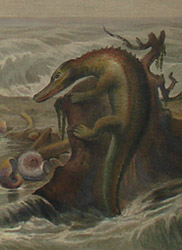
Detail of Plate 6 |
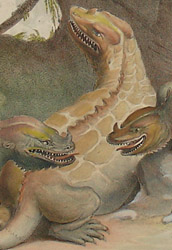
Detail of Plate 9 |
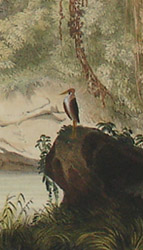
Detail of Plate 11 |
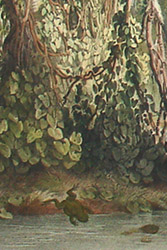
Detail of Plate 12 |
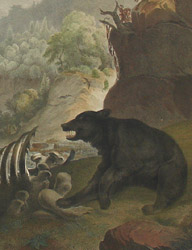
Detail of Plate 13 |
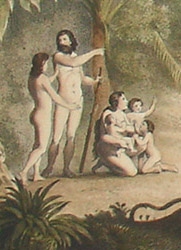
Detail of Plate 14 |
Complete series of 14 sequential prints showing the development of life on earth in different geological periods, from the earliest era then posited through the fossil record to the dawn of man. Originally published in 1851 in Vienna, these plates represent "the most ambitious project of its kind yet undertaken." (Rudnick) They are considered “a landmark in the popularization and visual representation of paleontology," (Gliboff) and one of the first attempts to visualize the modern conception of biological evolution, eight years before Darwin published The Origin of the Species. Each print image is set within a decorative border, and the geological period, as then posited, is printed as the title in the lower margin in German and in French.
The original watercolors paintings upon which the prints are based were a collaboration of two Austrians: Josef Kuwasseg, a landscape painter in the Romantic vein, and Franz Unger, a university professor, botanist and paleontologist, who commissioned Kuwasseg to illustrate his theory of the development of life based on his studies of the fossil record. Unger initially resisted the suggestions of his students and colleagues to collaborate with an artist to visualize his ideas, lest the interpretation become too fanciful and unscientific. He was skeptical when a fellow botanist suggested Josef Kuwasseg, who although an accomplished and successful landscape painter, was not a natural history artist. Kuwasseg's initial sketches won Unger over, and the two worked together to visualize his conception of the various eras represented in geological strata, with a special emphasis on plant life, given Unger's background as a botanist. The images also include the emergence of reptiles (sea and land), birds, amphibians, mammals and, in the last illustration, human beings. The original watercolors currently are in the collection of the Landesmuseum Joanneum in Graz, Austria, and were exhibited there in 2006.
Kuwasseg’s paintings were first lithographed in 1851 for Die Urwelt in ihren verschiedenen Bildungsperioden, as a set of 14 prints in a folio atlas, along with an explanatory booklet in German and French (offered here as a loose set of 14 prints). In the booklet, Unger praised Kuwasseg for patiently working through "frequent trials" to finally attain "such a perfect comprehension of the conceptions I had formed of these remote periods, that the undefined visions of my fancy were, by his genius, developed into clear and vigorous images." Die Urwelt was enthusiastically received by Unger's scientific colleagues in Vienna and abroad. A magic-lantern show of its images attracted large audiences throughout Europe in 1852 and 1859 as well as at the World's Fair in London in 1861. Various editions of the work were issued, including the one offered here, printed in Munich with 14 plates in 1851, a second edition published by T.O. Weigel in Leipzig in 1858 with two additional plates, and a third edition in 1864. Nonetheless, extant examples of the work in any edition are now very rare.
Franz Unger is an important figure in pre-Darwinian theories about evolution. He had an inquisitive mind and a wide range of research interests, as well as an individualistic streak that questioned conventional wisdom. During the 1830s and '40s, he published innovative works on cell biology, plant pathology, geographical distribution of plants, and fossils. He also aspired to find a unifying explanation of the history and nature of life. As he gradually integrated his knowledge of these various disciplines, he evolved an understanding of the origins of present-day species and rejected theories that then held sway such as "spontaneous generation." In 1851, he made the bold assertion that new plant species developed from old ones and that all plants had developed from a single ancestor, most likely a single cell. In addition to publishing these ideas in a scholarly text on botany, he also published a popular illustrated version as Die Urwelt (as offered here), which explicated his view of plant development as that of successive interdependent assemblages of flora in which some individual species had faded away and others had continued into later eras.
Josef Kuwasseg was an Austrian artist from a family of artists that also included his brothers Karl-Josef and Leopold and his nephew Charles-Euphrasie. Josef worked primarily in watercolors and lithography and was best known for his landscapes – idealized and actual, topographical paintings and architecturals. Notable works include a series of views of Graz, Austria, where he lived and books on drawing. Kuwasseg executed a series of watercolors imagining the development of life on earth, in collaboration with scientist Franz Unger – among the earliest visual conceptions of evolutionary biology. These watercolors were also issued as prints in Die Urwelt (as offered here).
Leopold Rottman was a German landscape painter and lithographer, who belonged to a family of artists that included his father Friedrich and his brothers Anton and Carl. Maximilian II of Bavaria was his patron. His works are in a number of European museums, including the National Gallery at Stuttgart and the chateau of Hohenschwangau.
Sebastian Minsinger (1800-64) was a lithographic publisher in Munich, Germany.
Inscriptions: "Gez. v. Kuwasseg'" [Drawn by Kuwasseg]; "Gedr. b. S. Minsinger in Munchen v. A. Geisberger" [Printed by S. Minsinger in Munich by A. Geisberger]; "Lith. v. Leop. Rottmann" [Lithographed by Leopold Rottmann]
References:
Bénézit, E. Dictionnaire critique et documentaire des Peintres, Sculpteurs, Dessinateurs et Graveurs. France: Librairie Gründ, 1966. Vol. 5, p. 333 (Kuwasseg); Vol. 7, pp. 378-379 (Rottmann).
"Die Urwelt. Fossile Reste und ihre gemalte Interpretation." 2006. Landesmuseum Joanneum. http://www.museum-joanneum.steiermark.at/cms/beitrag/10229994/10259359/ (30 March 2007).
Gliboff, Sander. "Evolution, Revolution, and Reform in Vienna: Franz Unger's Ideas on Descent and Their Post-1848 Reception." Journal of the History of Biology 31: 179-209, 1998.
"Joseph Kuwasseg 1799-1859." Leykam Buchverlag. www.leykamverlag.at/www/shop/detail.php?ID=32 (30 March 2007).
Rudnick, Martin J.S. Scenes from Deep Time. Chicago: University of Chicago Press, 1995, pp. 98-99.
Systematischer Katalog der Bibliothek der K.K. Technischen Hochschule in Wien. Originally published Vienna: Adolf Holzhausen, 1904, p. 36. Online at books.google.com.