R. Holme of York (engraver)
Jedidiah Buxton -- Aetat. 60
London or York, England: c. 1754-1772
Black-and-white engraving
16 x 10 inches
Sold, please inquire as to the availability of similar items.

Portrait of Jedidiah Buxton
Engraving c. 1754-1772
Engraving c. 1754-1772
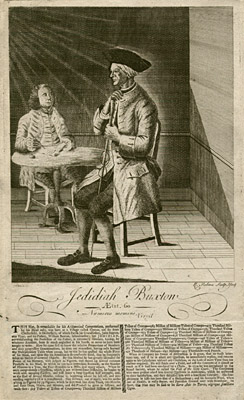
Portrait of Jedidiah Buxton (1707-1772), an arithmetical genius in Georgian England. Buxton is seated in a chair next to a table at which another man is seated. Buxton apparently was a savant, that is, he had a remarkable ability to perform difficult mathematical calculations in his head, yet he had not been formally educated. The print itself contains a lengthy biographical narrative which speaks of Buxton in the present tense, and so appears to have been made during his lifetime. Another interesting anecdote is provided by the editors of Britain's New National Dictionary of Biography (Oxford University Press, 1997): "Buxton, a self-taught 'mental calculator', worked out the exact date he would die and on that day bade farewell to all, went home, ate his supper, and died in his chair."
The print is subtitled with a quote by the famous ancient Roman philosopher Virgil: "Numeros memini." Buxton's talents are detailed in a lengthy caption:
This Man, so remarkable for his Arithmetical Computations, performed by his Head only, was born at a Village called Elmton, not far from Chesterfield, in Derbyshire, of which Parish his Grandfather, John Buxton, was Vicar, and his Father, William Buxton, Schoolmaster; but Jedidiah, notwithstanding the Profession of his Father, is extremely illiterate, having, by whatever Accident, been so much neglected in his Youth, as never to have been taught to write. How he came first to know the relative Proportions of Numbers and their progressive Denominations, he does not remember, having only learned of his Mind, and upon this his Attention is so constantly fixed, that he frequently takes no Notice of external Objects. By this Method he has greatly increased the Power of his Memory, with respect to Figures, and stored up several common Products in his Mind, to which he can have immediate Recourse, as the Number of Minutes in a Year, the Hair-Bredths in a Mile, and many others. When he once comprehends a Question, which is not without some Difficulty, he begins to work with amazing Facility, and will leave a long Question half wrought, and, at the End of several Months, resume it, beginning where he left off, and proceeding regularly till it is completed [sic]. One Instance, out of many, was his multiplying 39 Figures by 39 Figures, which he says took him three Years, two Months, and some Days, Hours, and Minutes. [Computation result listed].
When in Company his Power of Abstraction is so great, that no Noise interrupts him, and if he is asked any Question, he immediately replies, and returns again to his Calculation without any Confusion, or the Loss of more Time than his Answer required. He will stride over a Field, and tell the Contents of it almost as exact as if it had been measured by a Chain. In 1754 he was introduced to the Royal Society, whom he called the Volk of the Siety Court. The Gentlemen who were present asked him several Questions in Arithmetic, which he answered to their Satisfaction, and they dismissed him with a handsome Gratuity. His Employment in Life has been that of a Husbandman; and his favourite Food, when out of Health, is rusty Bacon, and Pancakes strewed over with Brimstone. In short, this Man may be said to be Rara Avis in Terris, Nigroque Simillima Cygno.
Reference:
Baigent, Elizabeth, ed. "Meanwhile at 37a St. Giles'…" New NDB Newsletter No. 3. Oxford University Press. December 1997. http://www.oup.co.uk/newdnb/html/newsletter3-main.html (15 January 2003).