Charles Wilson Peale (1741-1827) (after)
Albert Rosenthal (1863-1939) (etcher)
Benjamin Franklin
American: c. 1884-1900
Etching
Signed lower right
13.25 x 9.25 inches, overall
7 x 5 inches, plate mark
Sold, please inquire as to the availability of similar items.

Benjamin Franklin
After Charles Wilson Peale, c. 1884-1900
After Charles Wilson Peale, c. 1884-1900
This item is sold. It has been placed here in our online archives as a service for researchers and collectors.
- Please inquire as to the availability of similar items currently in stock, or use the navigation bar above to browse our site for currently available items.
- Find guidelines for the use of images from georgeglazer.com.
- To see more archived items, view our directory.
- Find information about selling your art and antiques.
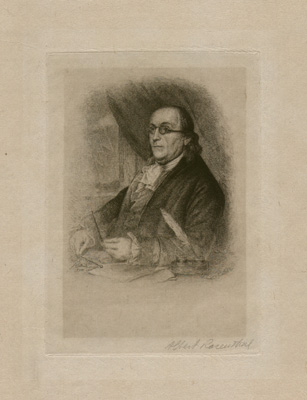
Etching after an 18th-century painting of Benjamin Franklin by Charles Wilson Peale, the original of which is in the collection of the Historial Society of Pennsylvania (see References below). The original portrait was commissioned by the American Philosophical Society toward the end of Franklin 's life. It focuses on Franklin as scientist and inventor of the lightning rod, as lightning flashes in the sky outside the curtained window. On his desk is a passage from his Experiments and Observations on Electricity and he holds what he viewed as the preferred type of rod, one with a pointed tip. A rod with a knob at the tip, which Franklin thought was dangerous, sits on the desk. He was very critical of King George of England for installing such rods on his palace, so the painting has political connotations as well.
Charles Wilson Peale was one of the major figures in early American art, as well as a true man of the Enlightenment--naturalist, curator, inventor, army captain during the Revolutionary War, and even putting in a brief stint as a state legislator in Pennsylvania. A painter and engraver best known for his portraits, he spent his youth in Maryland but later settled in Philadelphia. He studied art in Boston and went abroad to London , where he learned miniature painting, engraving and sculpting. Right after the Revolution, he established a museum of art and natural history in Philadelphia, which featured his portraits of prominent Americans and his natural history collection. He was also instrumental in founding the Pennsylvania Academy of Fine Arts in 1806. He was the patriarch of a family of artists, which included four of his sons, his brother, and several nieces and nephews.
Albert Rosenthal was a painter, etcher, and lithographer from New Hope, Pennsylvania. He studied under his father, printmaker Max Rosenthal, with whom he issued a series of portraits of men prominent in American history beginning in 1884. He also studied at the Pennsylvania Academy of Fine Arts and for three years under Gerome at the Ecole des Beaux-Arts in Paris. Returning to the U.S. in 1892 he became a portrait painter in Philadelphia and exhibited widely in the U.S.
References:
Fielding, Mantle. Dictionary of American Painters, Sculptors and Engravers. Green Farms, Connecticut: Modern Books and Crafts, 1926, rev. ed. 1974 (re Peale, p. 273-4 and Rosenthal, p. 309).
"Franklin and His Friends: Portraying the Man of Science in Eighteenth-Century America." National Portrait Gallery, Smithsonian Institution. 2000. http://www.npg.si.edu/exh/franklin/bfpeale.htm (21 November 2003).
"Charles Wilson Peale." AskArt.com. http://www.askart.com (21 November 2003).