Basil Ede (b. 1931)
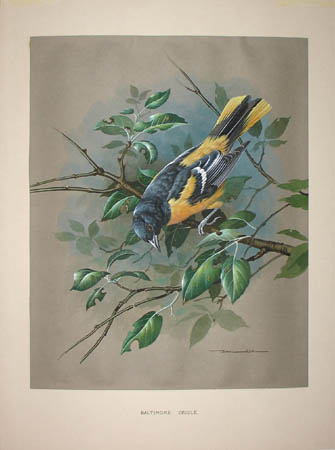
Baltimore Oriole
British: c. 1970s-1980s
Signed lower right: Basil Ede
Watercolor and gouache on grey paper, mounted to white card
16 x 12.5, painting
20.75 x 15. 5 inches, card
Sold, please inquire as to the availability of similar items.

Basil Ede -- Original Watercolor
Baltimore Oriole
Baltimore Oriole
This item is sold. It has been placed here in our online archives as a service for researchers and collectors.
- Please inquire as to the availability of similar items currently in stock, or use the navigation bar above to browse our site for currently available items.
- Find guidelines for the use of images from georgeglazer.com.
- To see more archived items, view our directory.
- Find information about selling your art and antiques.

 |
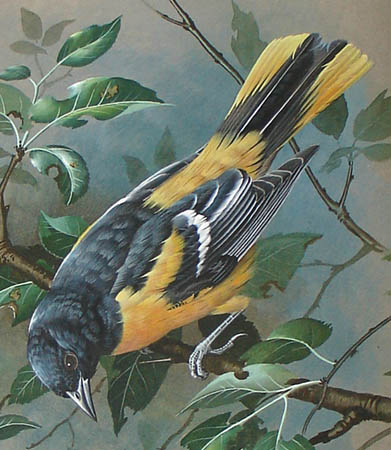 |


Above, from top: Painting, full view, detail, signature, and the title.
An original watercolor and gouache painting of a male Baltimore oriole (Icterus galbula) by Basil Ede, one of the best 20th century ornithological artists. This bird is native to North America, though it may winter as far south as the northern tip of South America. In the painting, the distinctively colored black and orange bird perches on a twig, its body angled as if poised to fly to the ground. The artist has cleverly echoed the white arc on the wing with the subtle highlights on the curving leaves surrounding it. The simple background conveys the effect of light filtering through the leaves of a tree on a sunny day. This work is an example of why Basil Ede is so highly regarded as a bird artist: he accomplishes the complex feat of incorporating painstaking detail of forms, plumage, and the surrounding foliage within an artistic composition that is nonetheless natural and lifelike. The painting is mounted, probably as issued, to white card, with title in block letters centered in the lower margin of the mounting board, possibly in the artist’s hand.
Basil Ede was born in Surrey, England, and as a child became familiar with the wildlife in the surrounding countryside. He befriended a local artist for the Zoological Society and received some informal instruction in natural history drawing. As a 25 year-old ship's purser, he traveled to the Far East, where he was inspired by Asian art. Meanwhile, he had also taken up bird-watching as a hobby, and decided to bring these two avocations together. He began exhibiting in London in 1958 at the Tryon Gallery, the first specialist wildlife gallery there. By 1964, he was able to devote his full time to ornithological painting. That year, he had his first American show at the Smithsonian's National Collection of Fine Arts in 1964 – the first ever given at that institution to a living artist -- and prepared 36 plates for the popular book Birds of Town and Village, published the following year and reprinted in several subsequent editions. Kennedy Galleries in New York became his American dealer in 1966, and published a catalog of his work to accompany an exhibition in 1979 of more than 30 paintings. These included paintings commissioned by Jack W. Warner, CEO of Gulf Paper States Paper Corporation in Tuscaloosa, Alabama, for a series of life-size bird paintings, Wild Birds of America. This project spanned the years 1975 to 1989, and the paintings became the basis for a series of limited edition prints. Ede's works have also been collected by Prince Philip of Great Britain and the Ulster Museum in Northern Ireland, among others, and have been featured in numerous other gallery and museum exhibitions.
Throughout his career, Basil Ede traveled the world to observe birds in their habitats, taking photographs and making sketches. He also has typically made use of museum specimens. In the introduction to the 1981 book Basil Ede's Birds, Ede explained that he conceived of his bird portraits in terms of the personality of the species, as expressed by "the movement of the body" and "deployment of feathers." He painted in watercolor, in a process that took him from rough sketches to the "painstaking and time-consuming finish." Ede’s extraordinary abilities were summed up by Carl W. Buchheister, President Emeritus of the National Audubon Society, in the preface to Basil Ede's Birds:
Technical ability is, to be sure, essential for the artist, but to impart lifelike qualities and personality to one's subjects requires the abilities of the true master. … This can be acquired only from long hours in the field, in an intimate study of the living bird. … Every Ede painting gives eloquent manifestation of such knowledge and understanding.
References:
Dougall, Robert et al. Basil Ede's Birds. New York: Van Nostrand Reinhold, 1981.
Wunderlich, Gerold M. Basil Ede: American Birds. October 17th to November 10th, 1979. New York: Kennedy Galleries, 1979.