Mark Catesby (1683-1749) (artist and etcher)
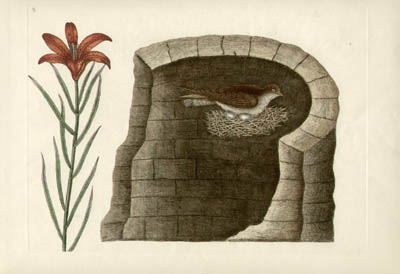
Hirundo Cauda Aculeata Americana: American Swallow. Lilium angustifolium, flore rubro singulari. (Appendix, Pl. 8)
from
The Natural History of Carolina, Florida, and the Bahama Islands
Benjamin White, London: 1771 (third edition)
Hand-colored engraving on wove paper
10.25 x 14.75 inches, plate mark
14. x 18 inches, overall
Sold, please inquire as to the availability of similar items.
To view our other Catesby prints please type "Catesby" into our site search engine.
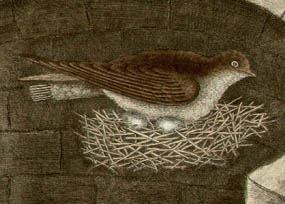
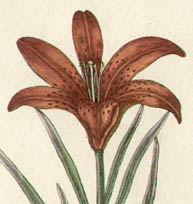
Natural history print of a cutaway view of a chimney where an American swallow nests, sitting on two white eggs. To the left is a single lily plant with a red flower (Lilium angustifolium, flore rubro singulari). The print is from a 1771 century reissue of Mark Catesby’s The Natural History of Carolina, Florida and the Bahama Islands (1729-1747).
Catesby wrote the following description of this print, in which he theorizes that the swallow migrates between Virginia and the corresponding southern latitude in Brazil. This text is transcribed from the 1754 edition.:
The American Swallow
This is a little less than the English House-Swallow, but very like it in shape. It is all over of a brown colour, except that the under-part of the body and tail is of a lighter brown; particularly the throat is almost white. The Cock has some feathers faintly stained with purple, except which he differs not in colour from the Hen. The singularity of this Bird is, that the shafts of the tail-feathers are very stiff, sharp-pointed, and bare of feathers at their ends, which seem designed by Nature for the support of their bodies, while they are in an erect posture building their nests, which they do in chimnies, with little sticks interwoven and cemented together with a kind of glue, or gum. Their periodical retiring from, and returning to Virginia and Carolina, is at the same seasons as our Swallows do in England; therefore the place they retire to from Carolina is I think most probably Brazil, some part of which is in the same latitude in the southern hemisphere, as Carolina is in the northern, where the seasons reverting, they may by this alternate change enjoy the year round an agreeable equality of climate; and what strengthens the probability of it is, that the description of the Brazilian Andarinba of Margravius agrees well with that of this Bird, except that he takes no notice of the spines in the tail, which he might probably overlook.
N.B. If it were ascertain’d that this Virginia Swallow was the same of Margravius’s Anderinba, it would, I think, confirm that most probable hypothesis, That Birds of passage (particularly Swallows) pass to the same latitude in the Southern Hemisphere, as the northern latitude from whence they came.
Lilium angustifolium, flore rubro singulari
This Lily rises from the ground with one, two, or three upright stalks, each of them bearuing a single flower at the height of about thirteen inches. The leaves are narrow, and stained at their ends with purple. The flower consists of a pistil and six stamins, rising from the center of six deep scarlet petals spotted with very dark red or purple, and their back-sides covered with an hairy roughness, as is also the upper-part of the stalk. It is a native of Pensylvania, and blossom’d in Mr. Peter Collinson’s garden at Peckham, in 1743.
Catesby’s important work was the first comprehensive publication on the natural history of the New World, and it influenced both Audubon and Linnaeus among others. The original work contained 220 fine hand-colored, folio size plates after his natural history paintings, many of which he etched himself, together with descriptions in English and French. Almost half the pictures depicted birds, the rest portrayed various animals and plants. In 1754, George Edwards (1694-1773) revised and reissued both volumes and in 1771 the publisher Benjamin White reissued Edward's edition, adding Linnaean names to all Catesby's plants and animals.
Mark Catesby, a British scientist and illustrator, trained as a botanist. Beginning in 1712, he spent seven years in Virginia, amassing collections of plant and animal specimens which he shipped back to wealthy patrons in England. With their encouragement, he undertook his Natural History, returning to North America for an extended stay in 1722 as well as learning etching so he could control the quality of the final product. His depictions of birds, which comprise 109 of the 220 illustrations, contributed to the development of ornithological illustration due to several innovative qualities: their naturalism, the use of foliage backgrounds and the folio format. For decades Catesby’s books remained the definitive source for information about New World birds, consulted by the likes of Linnaeus, Thomas Jefferson and Lewis and Clark.
References:
Amacker, Kristy, ed. “Mark Catesby’s Natural History.” Mark Catesby’s Natural History: an e-text. http://xroads.virginia.edu/~ma02/amacker/etext/pre_4.htm (16 August 2004).
“Catesby, Mark...Appendix page 8.” Digital Library for the History of Arts and Material Culture, University of Wisconsin-Madison. 2000. http://libtext.library.wisc.edu/cgi-bin/DLDecArts/DLDecArts-idx?type=article&byte=251968&isize=M&q1=&q2=&q3= (16 August 2004).
Stewart, Doug. “Abstract of an Article on Mark Catesby” Smithsonian Magazine. September 1997. http://www.smithsonianmag.si.edu/smithsonian/issues97/sep97/catesby.html (25 June 2004).
The Library of H. Bradley Martin: Magnificent Color-Plate Ornithology. New York: Sotheby’s, 1989. pl. 65.