Angelica Kauffmann (1741-1807) (after)
William Wynne Ryland (1732-1783) (engraver)
Venus Presenting Helen To Paris, After His Retreat From Combat With Menelaus
W.W. Ryland, No.159 Strand, London: 1781
Color-printed stippled engraving
16 x 14 inches
Sold, please inquire as to the availability of similar items.

Venus Presenting Helen to Paris
After Angelica Kauffman, 1781
After Angelica Kauffman, 1781
This item is sold. It has been placed here in our online archives as a service for researchers and collectors.
- Please inquire as to the availability of similar items currently in stock, or use the navigation bar above to browse our site for currently available items.
- Find guidelines for the use of images from georgeglazer.com.
- To see more archived items, view our directory.
- Find information about selling your art and antiques.

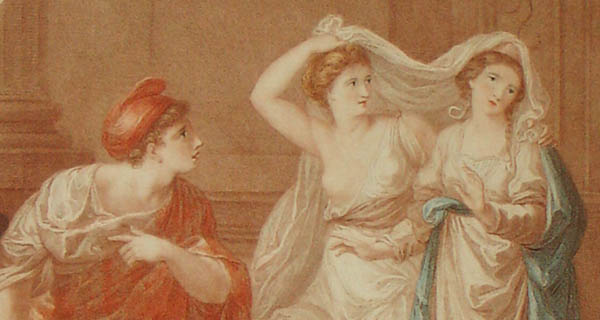
A story from Homer's Iliad is illustrated by the famous neoclassical artist Angelica Kaufmann. In brief, Paris was a young prince visited by three goddesses and asked to choose which was the most beautiful. Each of them promised him something in return for being selected, with Aphrodite (Venus) promising him that the most beautiful woman in the world would be his. He chose her and thus, according to legend, set in motion the events leading to the Trojan War. Helen, a princess and the fairest woman in the world, was promised by her parents to King Menelaus. Aphrodite brought Paris to the home of Menelaus and Helen, and Menelaus left for Crete. To Menelaus' surprise, Paris betrayed him and when he returned, Paris and Helen were gone. The Trojan war began. The scene depicted by Kauffmann occurs after Paris and Menelaus finally face each other to fight it out man to man. When Menelaus seems to have the upper hand, Paris is assisted by Aphrodite, escapes harm, and is spirited by her back to Troy, where Helen awaits him.
Angelica Kauffman was a child prodigy who was trained by her father, also a painter. From the age of 16 she traveled through Austria and Italy, assisting him with religious commissions as well as painting portrait commissions of her own. After arriving in London in 1766, she became known for her historical paintings, the most prestigious type of painting during the 18th Century. This engraving is among her historical subjects, which were taken from ancient as well as modern history. Kauffman achieved extraordinary recognition for a female artist of her day, and was one of only two female founding members of the British Royal Academy. She spent the latter part of her life in Italy.
William Wynne Ryland was a British engraver. Trained in France and Italy, he returned to England, skilled at a method of engraving that resembled a chalk drawing, and was appointed engraver to the King and Queen of England. After a partnership with another printmaker failed due to poor business practices, he opened his own business on the Strand. While he produced artistic prints like this one, he also turned his considerable talents as an engraver to forging money. Two years after this print was made, he was caught, tried and executed.
References:
Hamilton, Edith. Mythology. New American Library: New York, 1942, pp. 181-185.
Heller, Nancy G. Women Artists, An Illustrated History. Abbeville Press: New York, 1987, pp. 52-58.
McCain, Otis E. "William Wynne Ryland." 2001. http://genconnect.rootsweb.com/gc/surnames/r/y/RYLAND/biographies/146