Raphael Sanzio d'Urbino (1483-1520) (after)
Nicolas François Bocquet (d. 1716) (print artist and engraver)
The Judgment of Solomon
Rome: 1690
Copperplate engraving
12 x 10.5 inches
Sold, please inquire as to the availability of similar items.

The Judgment of Solomon
After Raphael, 1690
After Raphael, 1690
This item is sold. It has been placed here in our online archives as a service for researchers and collectors.
- Please inquire as to the availability of similar items currently in stock, or use the navigation bar above to browse our site for currently available items.
- Find guidelines for the use of images from georgeglazer.com.
- To see more archived items, view our directory.
- Find information about selling your art and antiques.
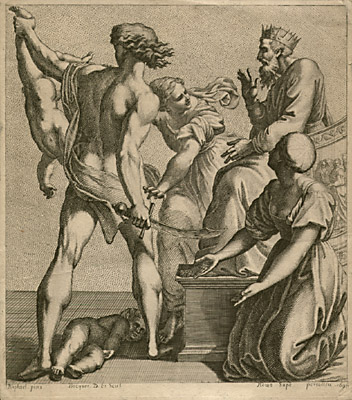
Depiction of one of the best-known Bible stories demonstrating the wisdom and cleverness of King Solomon, after a fresco ceiling panel by Raphael in the Stanza della Segnatura at the Vatican in Rome (1509-1511). The original painting can be viewed online (see Reference below). The story is told in I Kings 3:16-28. Two women came to his court in a dispute over a baby they each claimed to be their own. Solomon called for a sword and ordered that the baby be split in half. One woman agreed, but the other begged the King to spare the baby and give it to the other woman. Solomon declared that this proved without a doubt that the second woman was the real mother.
Raphael was one of the three greatest artists of the Italian High Renaissance and an accomplished architect as well. As chief archeologist to the Pope, he was involved in the excavation of the ancient Golden House of Nero, and adapted many of the elaborate Roman frescoes he saw there in creating his own innovative painted wall and ceiling designs in the Vatican and private villas in Rome. Prints made after Raphael’s drawings, designs and paintings were produced during his lifetime by the engraver Marcantonio Raimondi (c.1470-1482 - c. 1527-1534). Raphael prints by other engravers were especially popular in the neoclassical period of the mid 18th century and early 19th century coinciding with the tremendous revival of interest in the classical art of ancient Greece and Rome, as well as the classicism of the Renaissance. Some of these prints served as references for architects and designers because many were based on frescoes that had been incorporated into interior architecture. This interest in Raphael, often reflected in prints, continued throughout the 19th century as he achieved legendary status.
Among the more famous prints after Raphael are series from the late 18th century illustrating his frescoes in the Vatican stanze (notably Picturae Raphaelis Sanctii Urbinatis,Rome: 1722); the Vatican loggia (notably Loggia di Rafaele nel Vaticano, Rome: 1772-77) and the Villa Farnesina in Rome (notably Psyches et Amoris Nuptiae ac Fabula, Rome: 1693). One popular set, variously issued as engravings and lithographs during the 19th century, shows details of Raphael’s allegorical frescoes of 12 hours of the day and night. A related set of engravings depicts the gods and goddesses of the Roman pantheon riding in chariots in their heavenly domain, probably representing the seven days of the week.
Nicolas François Bocquet was a French artist active from 1691 to 1703.
Reference:
"Raphael. The Judgment of Solomon (ceiling panel)." Olga's Gallery. http://www.abcgallery.com/R/raphael/raphael66.html (6 February 2009)