James Millar (act. 1763-1805) (after)
Peter Rothwell (engraver)
Shylock & Portia
Whitworth & Yates, Birmingham, England: May 1, 1785
Sepia stipple engraving
14.75 x 12.25 inches, overall
Sold, please inquire as to the availability of similar items.

Shylock & Portia -- The Merchant of Venice
Sepia Engraving, England: 1785
Sepia Engraving, England: 1785
This item is sold. It has been placed here in our online archives as a service for researchers and collectors.
- Please inquire as to the availability of similar items currently in stock, or use the navigation bar above to browse our site for currently available items.
- Find guidelines for the use of images from georgeglazer.com.
- To see more archived items, view our directory.
- Find information about selling your art and antiques.
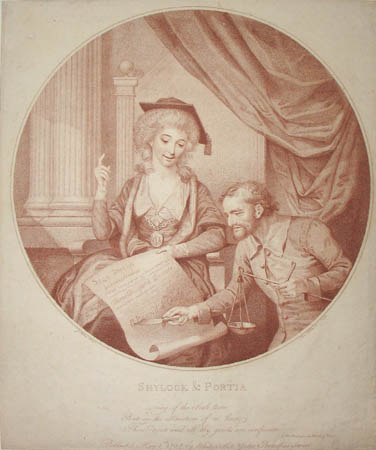
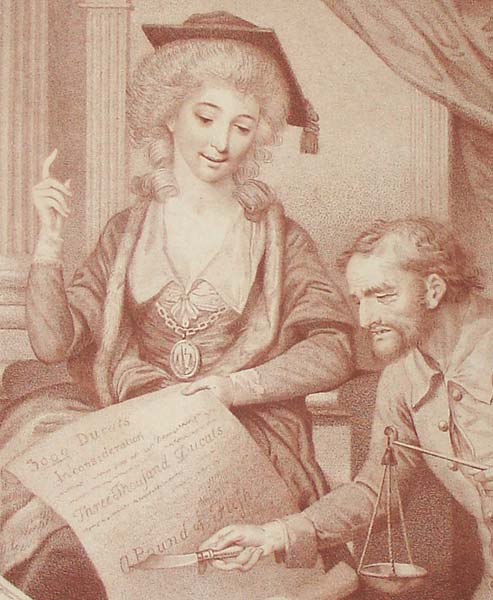
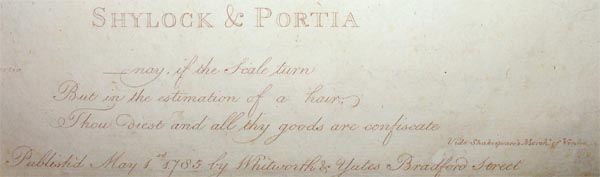
Illustration of Act 4, Scene 1 of William Shakespeare's play The Merchant of Venice, the climactic courtroom scene. The picture shows the wealthy heiress Portia, seated in judgment on a throne, with the moneylender Shylock, as they discuss the disputed contract he made with the character Antonio. Portia displays the unrolled contract promising "3000 Ducats" to the diminutive Shylock, who holds a scale in one hand as he points with a dagger at the final words of the contract, printed in large lettering: "A Pound of Flesh." Composed in a circular format, it is captioned by a line of dialogue spoken by Portia: "-- may, if the Scale turn/ But in the estimation of a hair, Thou diest and all thy goods are confiscate."
James Millar, a British painter who lived in Birmingham, was the leading portrait painter there in the last quarter of the 18th century. He painted aristocrats and luminaries such as John Baskerville, the typeface designer and printer; Joseph Priestly, the scientist who discovered oxygen; and Robert Mynors, a pioneering surgeon. He also produced history paintings and still lifes. Millar exhibited in London between 1771 and 1790. Today his paintings are in the collections of the National Gallery of Art, Washington; the National Portrait Gallery, U.K.; Oxford University and the Birmingham Museums and Art Gallery.
Whitworth & Yates was a publisher, as well as a brass foundry and metalworking firm, active in Birmingham, England, in the late 18th century.
Full publication information: "J. Millar Pinx't. Peter Rothwell Sculp. Publish'd May 1st 1785 by Whitworth & Yates, Bradford Street."
References:
Bénézit, E. Dictionnaire critique et documentaire des Peintres, Sculpteurs, Dessinateurs et Graveurs. France: Librairie Gründ, 1966. Vol. 6, p. 128.
"James Millar." National Gallery of Art. 2010. http://www.nga.gov/cgi-bin/tbio?tperson=6633&type=a (15 March 2010).