Raphael (after)
St. Marguerite Vierge et Martyre.
[St. Margaret, Virgin and Martyr]
Chereau, Rue St. Jacques, Paris: Late 18th or Early 19th Century
Etching
14 x 8.75 inches
Sold, please inquire as to the availability of similar items.

Etching of St. Margaret
After Raphael
After Raphael
This item is sold. It has been placed here in our online archives as a service for researchers and collectors.
- Please inquire as to the availability of similar items currently in stock, or use the navigation bar above to browse our site for currently available items.
- Find guidelines for the use of images from georgeglazer.com.
- To see more archived items, view our directory.
- Find information about selling your art and antiques.
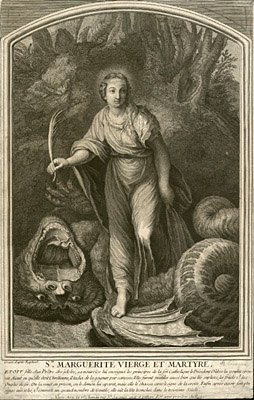
Portrait after Raphael of St. Margaret, calmly emerging unharmed from the belly of a dragon, which legend has it, swallowed her. The original painting is in the collection of the Louvre Museum. St. Margaret is a Martyr of Antioch in Pisidia, sometimes called Marina. Traditional stories about her life are summarized in the text at the bottom of the print (our translation):
"She was the daughter of a pagan priest, her nanny taught her the principles of the principles of the Catholic faith, the prefect Olybrius wanted to marry her. Having known that she was Christian, he tried to win her by caresses. They were useless, as well as the tortures, the whips and the bed of nails. She was put in prison, where the demon appeared to her, but she chased him away with the sign of the cross. Finally after having performed several miracles, and converted a great number of Gentiles, she was beheaded in the 3rd century."
[Bottom text reads, in French: Etoit fille d'un Prêtre des idoles, sa nourrice lui enseigna les principes de la foi Catholique le Président Olibre la voulut épouser. Aïant su qu'elle étoit Chrétienne, il tacha de la gagner par caresses. Elles furent inutiles aussi bien que les suplices, les foüets e les Ongles de ser. On la remit en prison, ou le demon lui aparut, mais elle le chassa avec le signe de la croix. Enfin après avoir fait plusieurs miracles, e converti un grand nombre de Gentils, elle eût la tête tranchée dans le troisième Siècle.]
Raphael was one of the three greatest artists of the Italian High Renaissance and an accomplished architect as well. As chief archeologist to the Pope, he was involved in the excavation of the ancient Golden House of Nero, and adapted many of the elaborate Roman frescoes he saw there in creating his own innovative painted wall and ceiling designs in the Vatican and private villas in Rome. Prints made after Raphael’s drawings, designs and paintings were produced during his lifetime by the engraver Marcantonio Raimondi (c.1470-1482 - c. 1527-1534). Raphael prints by other engravers were especially popular in the neoclassical period of the mid 18th century and early 19th century coinciding with the tremendous revival of interest in the classical art of ancient Greece and Rome, as well as the classicism of the Renaissance. Some of these prints served as references for architects and designers because many were based on frescoes that had been incorporated into interior architecture. This interest in Raphael, often reflected in prints, continued throughout the 19th century as he achieved legendary status.
Among the more famous prints after Raphael are series from the late 18th century illustrating his frescoes in the Vatican stanze (notably Picturae Raphaelis Sanctii Urbinatis,Rome: 1722); the Vatican loggia (notably Loggia di Rafaele nel Vaticano, Rome: 1772-77) and the Villa Farnesina in Rome (notably Psyches et Amoris Nuptiae ac Fabula, Rome: 1693). One popular set, variously issued as engravings and lithographs during the 19th century, shows details of Raphael’s allegorical frescoes of 12 hours of the day and night. A related set of engravings depicts the gods and goddesses of the Roman pantheon riding in chariots in their heavenly domain, probably representing the seven days of the week.
Chereau was a Parisian printer active in the late 18th and early 19th centuries. They produced a variety of prints, including topographical subjects and vues d'optiques.
Reference:
"St. Margaret." Catholic Online Saints & Angels. 1999-2002. http://www.catholic.org/saints/saint.php?saint_id=4474 (7 October 2002).