Henry William Bunbury (1750-1811) (after)
Francesco Bartolozzi (1727-1815)
(engraver)
Love and Honour
W. Dickinson, London: January 23, 1785
Brown ink stipple engraving
15.75 x 14.25 inches, plate mark
17.5 x 14.5 inches, overall
Sold, please inquire as to the availability of similar items.

Love and Honour
Stipple Engraving after Henry William Bunbury by Francesco Bartolozzi, London: 1785
Stipple Engraving after Henry William Bunbury by Francesco Bartolozzi, London: 1785
This item is sold. It has been placed here in our online archives as a service for researchers and collectors.
- Please inquire as to the availability of similar items currently in stock, or use the navigation bar above to browse our site for currently available items.
- Find guidelines for the use of images from georgeglazer.com.
- To see more archived items, view our directory.
- Find information about selling your art and antiques.
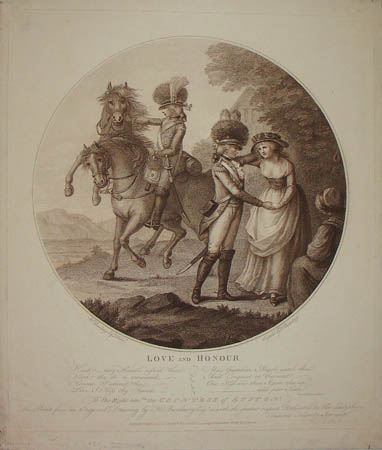
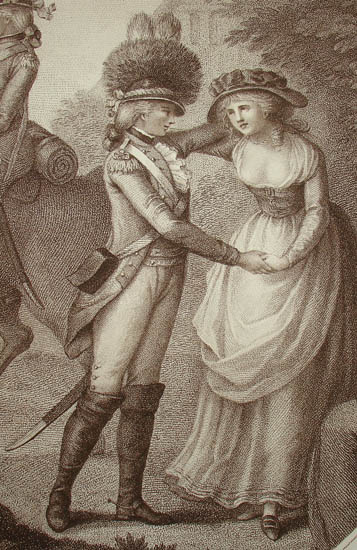
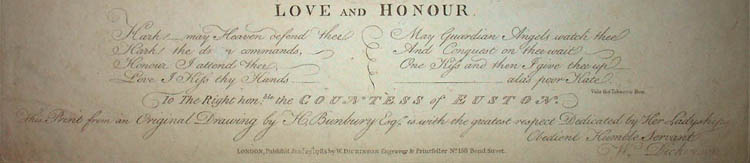
Two soldiers assist a young maiden in a country scene, illustrating the poem printed below, drawn and engraved by two prominent artists of late 18th-century London. The print is dedicated by the publisher to the Right Honorable Countess of Euston.
Love and Honour
"Hark may heaven defend thee,
Hark! The drawn commands,
Honor I attend thee,
Love I kiss thy hands.
May Guardian Angels watch thee,
And conquest on thee wait;
One kiss and then I give thee up,
_____ alas poor Kate."
Henry William Bunbury was a socially well-connected artist from the upper classes of British society, friends with prominent men like the painter Joshua Reynolds. After a Grand Tour in the late 1760s, he began a military career, and in 1787 he was appointed equerry to Frederick, Duke of York, and became a familiar and popular figure at court. He specialized in subjects from his experiences as a gentleman and courtier that also appealed to his patrons, including Cambridge, the Grand Tour, military life and horsemanship. Although the writer Horace Walpole compared him favorably to William Hogarth, when Bunbury ventured into satire, it tended toward gentle humor, rather than the scathing commentary of some of his 18th century contemporaries like Hogarth.
Francesco Bartolozzi was an engraver, etcher and painter born in Florence, Italy. He was trained in the Florentine Academy and apprenticed to a Venetian engraver. In 1764, King George III's librarian brought him to England, where he was appointed Engraver to the King and later held the title of Royal Academician. A prolific engraver, he developed a stipple method invented in France, and his work was admired for its subtle modulations of light and shade and his sensitive and graceful portrayal of the human form. Engravings were the means of creating reproductions of fine art in the pre-photographic age, and Bartolozzi was considered one of the best. Prominent artists such as Sir Joshua Reynolds praised his work. He spent the last 13 years of his life working and teaching in Lisbon, where he was knighted.
William Dickinson was a printseller and engraver in London, trading alone in business, mainly as a sole proprietor from 1773 to 1802. He was associated with Thomas Watson from 1776, and they traded as Watson and Dickinson from 1778 until Watson's death in 1781. In the early 19th century he moved to Paris, although he still supplied the London market from there. He died in Paris in 1823. Dickinson exhibited at the Society of Artists from 1768 to 1776. One of the finest mezzotint engravers of his time, he engraved portraits after Sir Joshua Reynolds and others.
Full publication information: To The Right hon'ble the Countess of Euston. This Print from an Original Drawing by H. Bunbury, Esq'r, is with the greatest respect Dedicated by Her Ladyships Obedient Humble Servant W. Dickinson. London, Publish'd Jan'y 23d, 1785 by W. Dickinson Engraving & Printseller No. 158 Bond Street.
References:
"Francesco Bartolezzi." Catholic Encyclopedia. http://www.newadvent.org/cathen/02319a.htm
"Henry William Bunbury." The Grove Dictionary of Art. Online at Artnet.com. http://www.artnet.com/library/01/0122/T012262.asp
Maxted, Ian. "The London book trades 1775-1800: a preliminary checklist of members." Exeter Working Papers in British Book Trade History. 24 July 2001. http://www.devon.gov.uk/library/locstudy/bookhist/lond.html (5 November 2004).
"William Dickinson." National Library of Australia. 17 June 2004. http://nla.gov.au/nla.pic-an9283218-1 (5 November 2004).