Joan Blaeu (c. 1599-1673) (after)
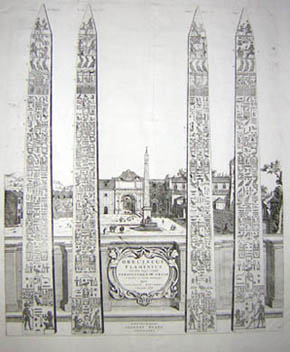
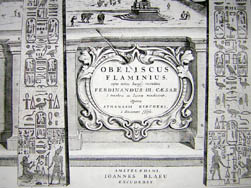
Obeliscus Flaminius
[Obelisk of Flaminius]
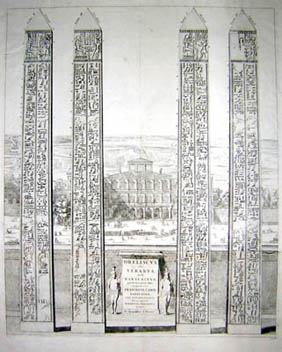
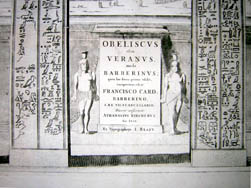
Obeliscus olim Veranus
[Obelisk Formerly of Veranus]
from Citta del Vaticano, Roma and Napoli
Joan Blaeu (heirs), Amsterdam: 1682
or P. Mortier, Amsterdam: 1704-05
Black-and-white engravings
30.25 x 25 inches, average approximate overall
26.5 x 21 inches, average approximate platemark
Sold, please inquire as to the availability of similar items.

Obelisks of Flaminius & Veranus, Rome
Blaeu & Mortier Early 18th Century Dutch Engravings
Blaeu & Mortier Early 18th Century Dutch Engravings
This item is sold. It has been placed here in our online archives as a service for researchers and collectors.
- Please inquire as to the availability of similar items currently in stock, or use the navigation bar above to browse our site for currently available items.
- Find guidelines for the use of images from georgeglazer.com.
- To see more archived items, view our directory.
- Find information about selling your art and antiques.
 |
 |
 |
 |
 |
 |
 |
To view other works by Blaeu, including maps and city views, type "Blaeu" in our search engine.
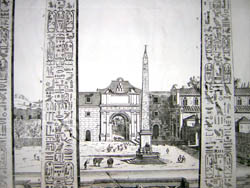
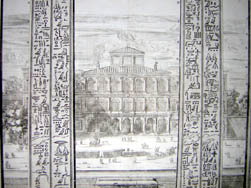
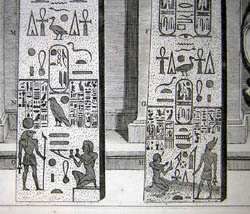
Pair of precise perspectival architectural drawings depicting ancient Roman obelisks as they would have looked when they were first erected. The four sides of the obelisks are depicted in the foreground of each rendering, with a view in situ appearing in the background. At the time Blaeu drew the obelisk of Flaminius, it had been erected in the Piazza del Popolo in Rome.
After Augustus defeated Anthony and Cleopatra and conquered Egypt in 30 BC, Egyptian culture exerted a major influence on Rome. Egyptian gods were incorporated into the Roman pantheon, and the idea of a connection between the great Pharaohs of the past to the Roman emperors was encouraged. Augustus brought two obelisks dedicated to the Pharaohs to Rome from Heliopolis. Over the next three centuries, the Roman emperors continued to erect other obelisks from Egypt or made in Rome. In the 16th century, most were destroyed, but thirteen remain in the streets of Rome today, thanks to Pope Sixtus V (1585-1590), who saved them and moved them from their original locations as focal points for his redesign of the streets and plazas. Some were Christianized by the addition of new inscriptions, crosses and heraldic symbols of the pope and placed in the center of piazzas or in front of basilicas.
Obeliscus Flaminius depicts an obelisk dating to the reign of the Pharaoh Seti I, who reigned from 1318 to 1304 BC. 75 feet tall, three sides were decorated under Seti, and the fourth by his son Ramses II, who erected it in the sun temple to honor the god Re at Heliopolis, an ancient Egyptian capital. Following the Roman defeat of Egypt, it was erected by the emperor Augustus at the Circus Maximus in Rome, a sporting and entertainment venue. It now stands in the center of the Piazza del Popolo, at the site that has always been the main entrance to Rome, where it was moved by Pope Sixtus V in the 16th century to create a perspective point for three major thoroughfares: Via Ripetta, Via del Corso and Via bel Babuino. Via del Corso is now a bustling shopping district.
The other print shows Obeliscus olim Veranus, that is “formerly of Veranus.” Perhaps this refers to the Ager Veranus, a tract about a mile outside Rome on the Via Tiburtina.
The dedications on these prints tie them to the writings of Athanasius Kircher, a German-born scholar who came to Rome in 1635 and became the chair of mathematics at the Jesuit Order’s Roman College. Kircher’s erudition encompassed a number of subjects, and at the time, he was the leading expert on Egyptian hieroglyphics. With the encouragement of Cardinal Francesco Barberini, he undertook a major study of Egyptian antiquity and published a book on the Coptic language. He also attracted the patronage of Emperor Ferdinand III of Austria, who underwrote the publication of two books, one of which was The Egyptian Language Restored (Lingua Aegyptiaca restituta) (1643). Kircher then published The Pamphili Obelisk (1650), illustrated with engravings of the Egyptian obelisk in front of the Pamphili pope's family palazzo on Piazza Navona, and his four-volume magnum opus Egyptian Oedipus (1652-54), the title of which was meant to imply that in interpreting the hieroglyphs, like the mythical hero Oedipus, he had succeeded in solving a great riddle. In point of fact, some of his contemporaries were skeptical, and rightly so; it would take the discovery of the Rosetta Stone centuries later to truly unlock the meanings of the hieroglyphs.
Full titles and dedications on the prints:
Obeliscus Flaminius; cujus notas hucus[?]; reconditas Ferdinandus III. Caesar è tenebris in lucem vindicavit, Opera Athanasii Kircheri, è Societate Jesu., XLII [Rough translation: Obelisk of Flaminius; which is known here; [?] Ferdinand III. Caesar claimed it from the darkness and brought in into the light, Work of Athanasius Kircher, from the Jesuit Society, XLII]
Obeliscus olim Veranus, modo Barberinus; quem hac forma primus edidit, interpretatus est, et Francisco Card. Baerberino, S. R. E. Vicecancellario, Dicavit consecravit Athanasius Kircherus Soc. Iesv, XLIX [Rough translation: Obelisk formerly of Veranus, more recently of Barberinus; the interpretation of which is first published here, and also Dedicated and consecrated by Athanasius Kircher, Jesuit Society to Francisco Cardinal Baerberino, S.R.E. Vice Chancellor, XLIX]
This engraving was originally published by Joan Blaeu, who published three town-books of Italy during his lifetime: Citta del Vaticano, Roma and Napoli. By the year 1672, a fire largely destroyed the main Blaeu workshop, and much of the prepared material. Nonetheless, work on the town-books continued, and in 1682 the completed work was published in Amsterdam by his heirs. The town-books were a great success and reissued several times by different publishers in Amsterdam, as late as 1726. Pierre Mortier reissued all the Blaeu plates in the years 1704-05 in an atlas comprising four volumes with the imprint of “A Amsterdam Chez P. Mortier Avec Privilege.”
The Blaeu family of cartographers, founded by Willem Janszoon Blaeu (1571-1638) in about 1604, became the largest printer in 17th century Europe and the leading cartographic publisher during the golden age of Dutch map making. Read more about the firm in our Guide to Globe Makers.
Pierre Mortier (1661-1711), a Frenchman, established a publishing house in Amsterdam by around 1685 and published or reissued maps by some of the great French and Dutch mapmakers of the late 17th and early 18th centuries, including Guillaume de L’Isle, Carel Allard, Jan Jansson and Joan Blaeu. After Mortier’s death in 1711, the family continued the business and later joined with Johannes Covens to form the firm Covens and Mortier, which also continued to publish Mortier’s maps and prints.
References:
“Circus Maxiumus.” Wikipedia. 14 December 2004. http://en.wikipedia.org/wiki/Circus_Maximus (15 December 2004).
Fleet, Christopher. "Joan Blaeu." Pont Maps Biographies. National Library of Scotland. 2000. http://www.nls.uk/pont/bio/blaeu.html (17 September 2002).
Piperno, Roberto. “Obelisks of Rome.” Rome Art Lover. 1999-2003. http://www.romeartlover.it/Obelisks.html (15 December 2004).
“Rome.” Nova Online Adventure. November 2000. http://www.pbs.org/wgbh/nova/egypt/raising/rome.html (15 December 2004).
"Rome Reborn: The Vatican Library & Renaissance Culture." Library of Congress. 2 July, 2002. http://www.loc.gov/exhibits/vatican/arch.html (17 September 2002).
Rowland, Ingrid D. “Athanasius Kircher and the Egyptian Oedipus.” Excerpted from The Ecstatic Journey: Athanasius Kircher in Baroque Rome by Ingrid D. Rowland, University of Chicago Library, 2000. University of Chicago Fathom Archive. http://fathom.lib.uchicago.edu/1/777777122590/ (15 December 2004).
Tooley, R.V. Maps and Map-Makers. 4th Ed. New York: Bonanza Books, 1970. pp. 33-34.