Georg Balthasar Probst (1732-1801) (artist and engraver)
Les Pyramides de L’Egypte, Troisiéme Miracle du Monde
L’Ampitheatre de Rome, Sixiéme Miracle du Monde
[The Pyramids of Egypt, Third Wonder of the World
Roman Colosseum, Sixth Wonder of the World]
Augsburg: 2nd Half 18th Century
Hand-colored engraving
10.25 x 16 inches, average approximate border
12.25 x 16.75 inches, average approximate plate mark
13.25 x 18.25 inches, average approximate overall
Sold, please inquire as to the availability of similar items.

Pair of Prints of Wonders of the World
18th Century Vues d’Optique by G.B. Probst
18th Century Vues d’Optique by G.B. Probst
This item is sold. It has been placed here in our online archives as a service for researchers and collectors.
- Please inquire as to the availability of similar items currently in stock, or use the navigation bar above to browse our site for currently available items.
- Find guidelines for the use of images from georgeglazer.com.
- To see more archived items, view our directory.
- Find information about selling your art and antiques.
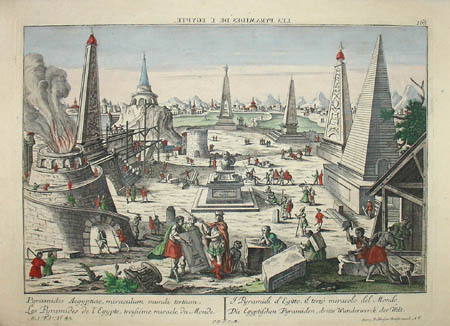
Les Pyramides de L’Egypte [Pyramids of Egypt]
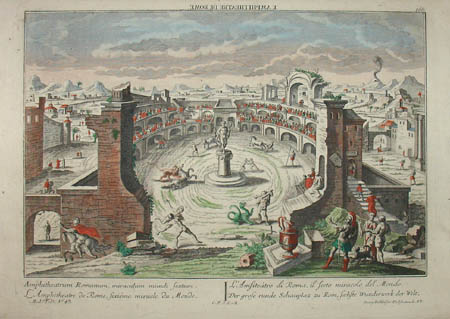
L'Ampitheatre de Rome [The Colosseum]
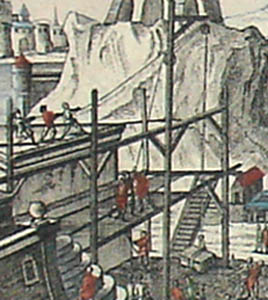
Detail of Les Pyramides |
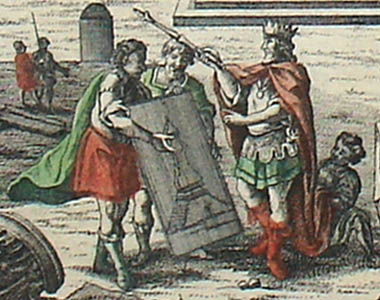
Detail of Les Pyramides |
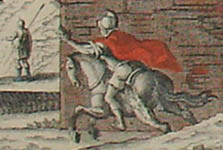 |
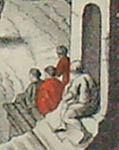
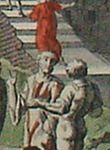
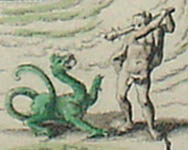
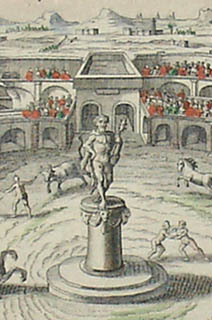
Above: Five details of L'Ampitheatre |
 |
Pair of vues d’optique from a series on the Seven Wonders of the World: the Pyramids of Egypt, identified as the third wonder, and the Colosseum in Rome, identified as the sixth wonder. Both are inscribed as belonging to Med. Folio No. 43, plates 163 and 166 respectively. Vues d’optique were intended as entertainment, and the prints are rich with visual incident.
The pyramids print depicts a plaza surrounded by obelisks and teeming with activity. Some of them are completed, some apparently under construction. It is clear that this scene is an entirely fanciful creation: the people are dressed in costumes that suggest Ancient Rome and Medieval Europe more than the Egypt of the pharaohs, the monuments resemble Roman structures like Trajan’s Column more than they do Egyptian pyramids, and the village and mountains beyond suggest Europe as opposed to the Middle East. In the foreground, a king is being shown a design, while stonecutters work to his right. Other men carry stones that have been cut into blocks. On the left, men wield a pulley on a monument under construction. There is also a round building that appears to be a furnace or kiln, surrounded by a ramp and emitting fire and smoke from the top. In the distance are a town and a mountain range.
The Colosseum print purports to show it during Roman times, although its future as a ruin is perhaps hinted at with a piece of broken column in the foreground. Within the ampitheater, several contests improbably take place simultaneously around a large statue on a column: men wrestling each other, another man about to be charged by a bull, a lion fighting a horse, and a man with a club about to strike a bright green dragon. Outside, people stand on the hill overlooking the structure, while others climb the steps to enter and passersby walk through nearby city gates. Beyond, mountains punctuate the horizon, including a volcano spouting a plume of smoke.
These engravings are in the general format and size of vues d’optique -- perspective views produced as hand-colored prints generally intended to be viewed through a convex lens. Vues d’optique often were rendered in high-key color and dramatic linear perspective that enhanced the illusion of three-dimensionality when viewed through the lens, making it seem like the viewer was really there. Thus, they served as a form of visual entertainment. The viewing devices were known variously as zograscopes, optiques, optical machines or peepshows. According to the Getty Research Institute, street performers would set up viewing boxes with a series of prints giving a pictorial tour of famous landmarks, dramatic events and foreign lands. Vues d’optique were also purchased by Grand Tour travelers as souvenirs to be viewed at home as a parlor activity. To cater to this broad audience, the prints often had titles and descriptions in two or more languages. Because the images are reversed in the viewing device, the main titles on some vues d’optique are backwards. Vues d’optique were also hung on walls as decoration.
Georg Balthasar Probst was a German artist, engraver and publisher in Augsburg, a major European publishing center in the 17th and 18th centuries. He produced architectural views of places around the world, including vues d’optique, which were published in various places during the last half of the 18th century, including Paris, Augsburg and London. He was also known for his portraits.
Probst came from an extended family of printers, whose businesses can all be traced back to the publishing firm of Jeremias Wolff (1663-1724). After Wolff's death his firm was continued as “Wolff’s Heirs” (Haeres Jer. Wolffii) by his son-in-law Johann Balthasar Probst (1689-1750). After Probst’s death in 1750, his descendants divided the business and published under their own imprints: Johann Friedrich Probst (1721-1781), Georg Balthasar Probst (1732-1801) and Johann Michael Probst. Another part of the Wolff-Probst firm was acquired by the Augsburg publisher Johann Georg Hertel (1700-1775), whose son Georg Leopold Hertel had married a sister of the Probsts. In the next generation, Georg Mathäus Probst (d. 1788), son of Georg Balthasar Probst, also became an engraver of portraits and views.
Inscriptions above Pyramids print: Titled center “Les Pyramides de L’Egypte” (typeset backwards) and numbered upper right: 163.
Inscriptions above Colosseum print: Titled center “L’Ampitheatre de Rome” (typeset backwards) and numbered upper right: 166.
Inscriptions below Pyramids print: Titled in Latin, French, German and Italian, “Pyramides Aegyptiae, miraculum mundi tertium. Les Pyramides de l’Egypte, troisiéme miracle du Monde. I Pyramidi d’Egitto, il terzo miracolo del Mondo. Die Egyptischen Pyramiden, dritte Wunderwerk der Welt.” Inscribed, “Med. Folio No. 43. C.P.S.C.M. [Cum Gratia et Privilegio Sacrae] Georg Balthasar Probst, excud. A.V.” [The Pyramids of Egypt, Third World Wonder. By the grace and favor of His Sacred Imperial Majesty. Georg Balthasar Probst made it in Augsburg.]
Inscriptions below Colosseum print: Titled in Latin, French, German and Italian, “Ampitheatrum Romanum, miraculum mundi Sextum. L’Ampitheatre de Rome, Sixiéme Miracle du Monde. L’Amfiteàtro di Roma, il Sesto miracolo del Mondo. Der grose runde Schauplaz zu Rom, Sechste Wunderwerk der Welt.” Inscribed, “Med. Folio No. 43 C.P.S.C.M. [Cum Gratia et Privilegio Sacrae] Georg Balthasar Probst, excud. A.V.” [Ampitheater of Rome (the Colosseum), Sixth World Wonder. By the grace and favor of His Sacred Imperial Majesty. Georg Balthasar Probst made it in Augsburg.]
References:
Bénézit, E. Dictionnaire critique et documentaire des Peintres, Sculpteurs, Dessinateurs et Graveurs. France: Librairie Gründ, 1966. Vol. 7, p. 32.
“Emperor’s Palace in Beijing.” Devices of Wonder. J. Paul Getty Trust. 2001. http://www.getty.edu/art/exhibitions/devices/html/homepage.html (30 September 2002).
Ritter, Michael. [Maphist] “Re: Friedrich Bernhard Werner panoramic maps of cities.” 6 March 2006 and 7 March 2006. MapHist Mailing List. List Information: http://www.maphist.info. (7 March 2006).