Nicolas Maréchal (after)
Simon Charles Miger (1736-1820) (engraver)
Comte de La Cépède, Georges Cuvier and Étienne Geoffroy Saint-Hilaire (authors)
Ursus Maritimus - L'Ours Polaire [Polar Bear]
from La Ménagerie du Museum National d'Histoire Naturelle ou Description et Histoire des Animaux Qui Y Vivent et Qui Y Ont Vécu
[The Menagerie of the National Museum of Natural History, or Description and History of the Animals That Live, or Have Lived, There]
Chez Miger and Ant. Aug. Renouard, Paris: 1801
Etching, uncolored
13.5 x 21 inches, overall
11.75 x 15.5 inches, plate mark
Sold, please inquire as to the availability of similar items.

Polar Bear
Nicolas Maréchal, 1801
Nicolas Maréchal, 1801
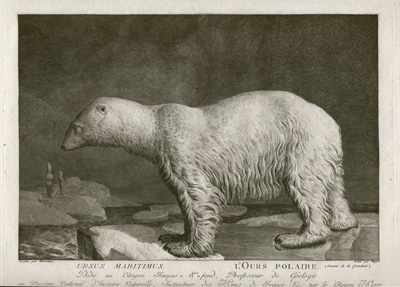
Natural history study after a watercolor painting by Nicolas Maréchal commissioned by the zoo affiliated with the Muséum National d'Histoire Naturelle to document the animals in its captivity. The bear is depicted in its natural habitat and is shown from the side. Textures of its coat illustrated in great detail.
In 1793, after the French Revolution, the former royal garden and collection became the Botanical Garden and the National Museum of Natural History. A zoo linked with the museum was also established, replacing the royal menagerie at Versailles. Until then, people had seen animals in traveling shows, where they were exhibited as curiosities. Traveling menageries were soon banned in Paris, ensuring a steady stream of visitors to the new zoo. The eminent naturalists La Cépède, Cuvier and Geoffroy compiled a catalog of the animals in the zoo in 1801. Nicolas Maréchal, the museum's painter, documented the animals of the new zoo in watercolor paintings on vellum.
Reflecting the post-Revolution political mores the personnel associated with this project are referred to as "citoyens" (citizens). The print is dedicated to "Citizen Faujas-St. Pond, Professor of Geology at the National Museum of Natural History, Inspector of Mines of France, etc., by Citizen Miger." (Dedication in French reads: "Dédié au Citoyen Faujas - St. pond; Professeur de Géologie au Muséum National d'histoire Naturelle, Inspecteur des Mines de France &c, par le Citoyen Miger.")
The engraver and co-publisher of this work was Simon Charles Miger (1736-1820), a French printmaker and member of the Royal Academy of Painting. The other publisher, Renouard, is identified on the title page of La Menagerie du Museum National d'Histoire Naturelle as a bookseller.
Baron Georges Cuvier (1769-1832) was a French naturalist, considered the father of comparative anatomy, who introduced the concept of phylum and is credited with almost single-handedly founding the discipline of vertebrate paleontology. In 1795 he came to Paris at the invitation of Geoffroy Saint-Hilaire, where he became a professor of animal anatomy and superintendent of the zoo at the Museum of Natural History. Cuvier's comparisons improved and extended the Linnaean system of classification. He was recognized by being knighted and made a Baron and Peer of France. Bernard Germain Etienne de la Ville-sur-Illion, Comte de La Cépède was also a prominent naturalist, who dropped his title of "Count" after the Revolution. Étienne Geoffroy Saint-Hilaire (1772-1844) was also a French naturalist whose ideas about evolution influenced later naturalists. He collaborated with Cuvier on five works on natural history, although their conceptions of evolutionary biology ultimately diverged.
Full title and publication information: La Ménagerie du Museum National d'Histoire Naturelle ou Description et Histoire des Animaux Qui Y Vivent et Qui Y Ont Vécu, Par Les CC. LaCépède, Cuvier et Geoffroy, Avec des Figures peintes, d'aprés Nature, par Maréchal, Peintre du Muséum, Gravés, avec l'agrément de l'Administration, A Paris, Chez Miger, Graveur, quai des Miramiones, no. 106; Et Ant. Aug. Renouard, Libraire, rue Saint-André-des-Arcs, no. 42.
References:
"Étienne Geoffroy St. Hilaire." University of California, Berkeley, Museum of Paleontology. http://www.ucmp.berkeley.edu/history/hilaire.html (25 March 2004).
"Georges Cuvier." University of California, Berkeley, Museum of Paleontology. http://www.ucmp.berkeley.edu/history/cuvier.html (25 March 2004).