Sir Walter Scott
English: Late 19th Century
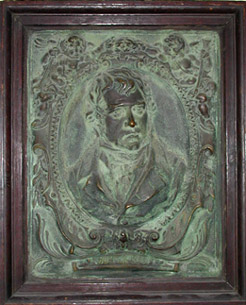
Patinated copper portrait relief plaque
16 x 12.5 inches, plaque
18.5 x 15 inches, oak frame
Sold, please inquire as to the availability of similar items.

Sir Walter Scott
Patinated Copper Portrait Relief Plaque
Patinated Copper Portrait Relief Plaque
 |
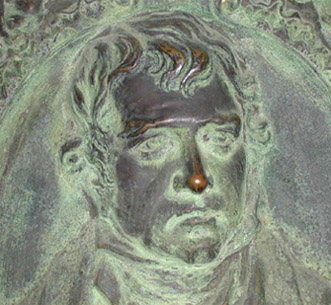 |
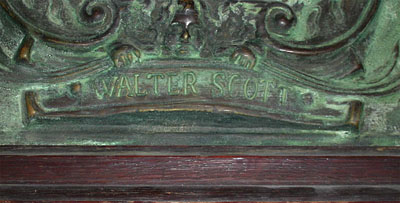
Portrait bust of Sir Walter Scott, set in oval cartouche with scrolled ornament, surmounted by two cherubs with trumpets holding a wreath over his head, with cherub head and name reserve "WALTER SCOTT" below. Executed in raised relief, cast repousse copper, with patinated bronzed/oxidized-copper finish. In dark stained oak frame.
Sir Walter Scott (1771-1832) was a novelist, poet, historian, and biographer who is often considered the inventor of historical novel. He began his literary career writing narrative poetry and editing multi-volume editions of John Dryden and Jonathan Swift. In 1814, he turned his attention to writing novels, and his first one, Waverley, was an immediate success. He followed up with a series of novels that, like Waverley, were set in his native Scotland and vividly depicted characters from all segments of Scottish society, the most popular of which is Ivanhoe, a story set in the 12th century.
Scott's achievement is described in this paragraph from the Encyclopædia Brittanica:
"Scott gathered the disparate strands of contemporary novel-writing techniques into his own hands and harnessed them to his deep interest in Scottish history and his knowledge of antiquarian lore. The technique of the omniscient narrator and the use of regional speech, localized settings, sophisticated character delineation, and romantic themes treated in a realistic manner were all combined by him into virtually a new literary form, the historical novel. His influence on other European and American novelists was immediate and profound, and though interest in some of his books declined somewhat in the 20th century, his reputation remains secure."
Reference:
"Scott, Sir Walter, 1st Baronet." Encyclopædia Britannica from Encyclopædia Britannica Premium Service. 2003. http://www.britannica.com/eb/article?eu=68079 (15 May 2003).