

Ancient Art & Architecture | Myths & Legends | Mapping the Ancient World
Click on the pictures for more information about individual items shown here,
many of which are for sale.
Beginning in the 18th century, archaeological excavations unearthed vases and artifacts that were documented in portfolios of prints and marketed to travelers on "the Grand Tour" and to aristocratic patrons for their libraries.
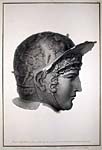
A Roman cavalry parade helmet was discovered in 1796 by a boy playing on the site of a Roman fortress in England. This engraving (above) was commissioned by the Society of Antiquaries, London, in 1799. 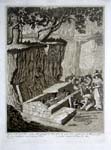
This print (above) depicts the removal of Ancient Greek vases from tombs as tourists look on. |

Prints of classical architecture were popular with educated Europeans throughout the 18th century and into the 19th. A Blaeu-Mortier print (above) of the Coliseum, printed in 1704-05. 
Giovanni Battista Piranesi was one of the leading figures in the development of the neoclassical style in the 18th century. As architect, artist, designer, collector, and antiquities dealer, he and his son produced a series of etchings and engravings (above) depicting the glories of ancient Rome. |

Greek painting survives mainly in painted vases, which recorded scenes of daily life, as well as stories from Greek mythology and history. Prominent collector Sir William Hamilton published extensive collections of prints reproducing the paintings on such vases (above).
Stuart and Revett's highly influential architectural book, The Antiquities of Athens (1762) (above left), was the first accurate survey of ancient Athenian architecture, anticipating the Grecian Revival style in England in the early 19th C. At right is a plate of the Tower of the Winds, which they excavated and recorded in the book. In the pre-photographic era, engravings of Greek and Roman statuary were created for documentation and study (above right). |
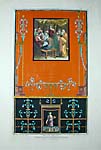
The discovery of the city of Pompeii in 1748, buried by a volcanic eruption in 79 AD, yielded Roman wall paintings in a remarkable state of preservation. Italian publishers produced prints (above) which served as souvenirs of "the Grand Tour," a trip through continental Europe undertaken by wealthy British citizens, focusing on sites of historical and cultural importance as well as natural wonders. |


Greco-Roman myths, legends and literature inspired artists from the Renaissance onward.
|
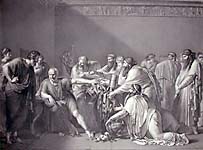
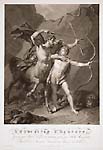
Hippocrates is shown refusing gifts brought by Alexander the Great. |
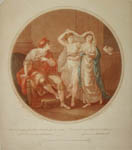
|

|

After Farinati, a scene from the tale of Phaeton, son of Helios |
![Vincenzo Coronelli, Gli Argonauti [The Argonauts]](../prints/aanda/art-pre20/coronelli-2.JPG) |
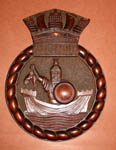
The mythic Greek maritime heroes Jason and the Argonauts remained popular symbols of navigation centuries later. The first geographic society, founded by 17th-century geographer Vincenzo Coronelli, was named for the "Argonauti." In 1695 he illustrated a scene from Jason's tale (left). The British Royal Navy has had four battleships named the HMS Argonaut between 1798 and 1993. The ship's badge from the third Argonaut, launched in 1941, is show at right. |
 |

Giulio Romano used the popular Renaissance motif of the conquering Cupid in a fresco panel, reproduced in this early 19th C. print. |
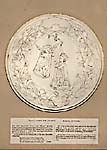
This 19th C. manuscript illustrates the zodiac signs, which are based on Greek mythology. |
![after Raphael, Tout L'Olympe en Rumeur [All Olympus in a Hubbub]](../prints/aanda/art-pre20/raphrumor-2.jpg)
All Olympus in a Hubbub by Renaissance master Raphael. |
 |
The 16th century Dutch cartographer Abraham Ortelius showed the extent of the ancient Roman Empire (left). An Art Deco style map produced in the 1930s was intended as a classroom aid for students learning Latin (right). |
 |