Raphael Sanzio d'Urbino (1483-1520) (after)
Stefano Tofanelli (1752-1812) (print artist)
Pietro Bonato & Pietro Bettelini (1763-1829) (engravers)
Gióve (Jupiter)
Marte (Mars)
Rome: 2nd Quarter 19th Century
Hand-colored engravings
17 x 20 inches, sheet
11 1/2 x 15 inches, image
Sold, please inquire as to the availability of similar items.
To see other Raphael prints on our site, use our site search engine.
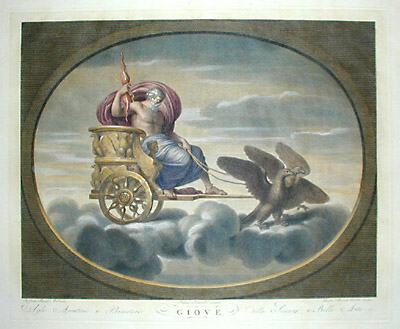
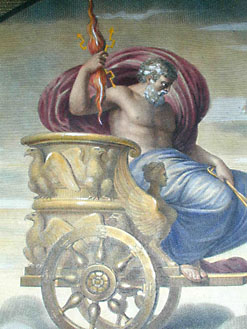
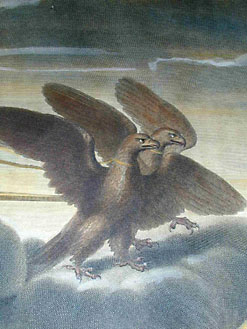
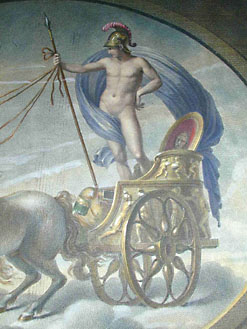
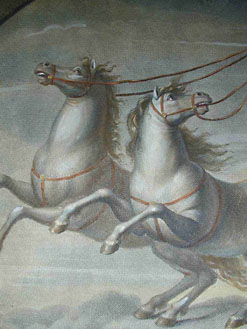
A pair of classical Roman gods in chariots in the clouds in the sky, each set in oval lozenge. Jupiter's chariot is drawn by a pair of eagles and decorated with gilt carved eagles and a pair of winged monopodia. He holds lightning bolts, his emblem (Jupiter was the Roman version of the Greek god Zeus). Mars, the god of war based on the Greek god Ares, is depicted as a nude male gladiator with a helmet and spear, on a horse-drawn chariot decorated with carved battle scenes. The print of Jupiter is dedicated, "Agli Amator e Promotori delle Scienze Belle Arti," i.e. to amateurs and professionals of the discipline of the fine arts. Mars is dedicated to various dignitaries and patrons.
Although the source of the imagery in these prints has been consistently attributed to Raphael, the location of the frescoes on which they perhaps were based is unknown. Perhaps the intermediary draftsmen who designed the prints loosely based them on portions of works by Raphael and otherwise created the compositions themselves. As with the famous set of 12 Raphael's Hours prints, presumably the frescoes on which they were based were destroyed or covered up some time in the 19th century, leaving the prints as the most celebrated and popular examples of these images. The Roman days of the week corresponding to Sunday through Saturday were Solis (associated with Apollo), Lunae (associated with Diana), Martis (Mars), Mercurii (Mercury), Jovis (Jupiter), Veneris (Venus) and Saturni (Saturn).
Raphael was one of the three greatest artists of the Italian High Renaissance and an accomplished architect as well. As chief archeologist to the Pope, he was involved in the excavation of the ancient Golden House of Nero, and adapted many of the elaborate Roman frescoes he saw there in creating his own innovative painted wall and ceiling designs in the Vatican and private villas in Rome. Prints made after Raphael’s drawings, designs and paintings were produced during his lifetime by the engraver Marcantonio Raimondi (c.1470-1482 - c. 1527-1534). Raphael prints by other engravers were especially popular in the neoclassical period of the mid 18th century and early 19th century coinciding with the tremendous revival of interest in the classical art of ancient Greece and Rome, as well as the classicism of the Renaissance. Some of these prints served as references for architects and designers because many were based on frescoes that had been incorporated into interior architecture. This interest in Raphael, often reflected in prints, continued throughout the 19th century as he achieved legendary status.
Among the more famous prints after Raphael are series from the late 18th century illustrating his frescoes in the Vatican stanze (notably Picturae Raphaelis Sanctii Urbinatis,Rome: 1722); the Vatican loggia (notably Loggia di Rafaele nel Vaticano, Rome: 1772-77) and the Villa Farnesina in Rome (notably Psyches et Amoris Nuptiae ac Fabula, Rome: 1693). One popular set, variously issued as engravings and lithographs during the 19th century, shows details of Raphael’s allegorical frescoes of 12 hours of the day and night. A related set of engravings depicts the gods and goddesses of the Roman pantheon riding in chariots in their heavenly domain, probably representing the seven days of the week.
The early 19th century saw a tremendous revival of interest in the classical art of ancient Greece and Rome, as well as the Classicism of the Renaissance. Prints such as these served both as art historical references for architects and designers and as artwork in their own right.