
Description
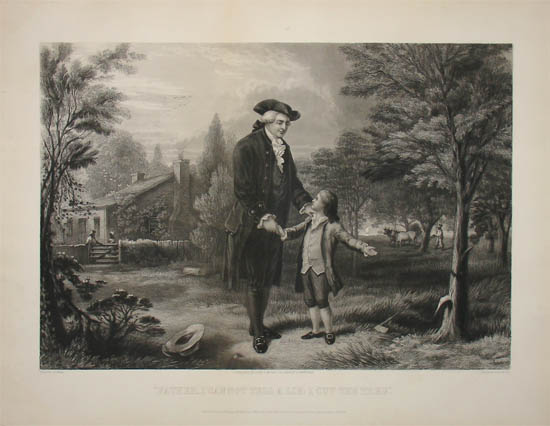
The tale of “Washington and the Cherry Tree” was popularized by Mason Locke Weems, an American parson who published it in a biography of Washington after he died in 1800. Washington’s accomplishments as general during the American Revolution, in which the colonists succeeded in defeating one of the most powerful militaries in the world, seemed nothing short of miraculous to his countrymen, and after his death he was treated with reverence in American art and literature. He also was known for his honesty and humility, and Weems’ story of the cherry tree resonated with people’s view of him as well as with 19th century moral values. Though 20th-century historians debunked the cherry tree story as apocryphal, Washington’s reputation for integrity and modesty derived from how he conducted himself in his adult life; he never sought his positions as general, presiding officer at the Constitutional Convention or as America’s president, but accepted these responsibilities at the insistence of his peers, who viewed him as the best man for the job.
George Gorgas White was a wood engraver and illustrator. Born in Philadelphia, he studied with John Cassin and worked there from 1854 to 1861. Thereafter he moved to New York City, where he spent the rest of his life.
John C. McRae was an engraver and print publisher in New York City, working in line and stipple from 1850 to 1880.
Full publication information: “Painted by G.G. White. Engraved by John C. McRae. Published by John C. McRae, 100 Liberty St. New York. Entered according to Act of Congress A.D. 1867, by John C. McRae in the Clerks Office of the U.S. District Court for the Southern District of New York.”
References:
Dove, Laura and Lisa Guernsey, et al. “The Moral Washington: Construction of a Legend (1800-1920s).” Apotheosis of George Washington: American Studies at the University of Virginia. 6 March 1997. http://xroads.virginia.edu/~cap/gw/gwmoral.html (15 March 2013).
“Father, I cannot tell a lie: I cut the tree.” Library of Congress. http://www.loc.gov/pictures/item/2006678327/ (15 March 2013).
Groce, George C. and Wallace, David H. The New-York Historical Society’s Dictionary of Artists in America 1564-1860. New Haven: Yale University Press, 1969. p. 418 (McRae), p. 680 (White).