




Description
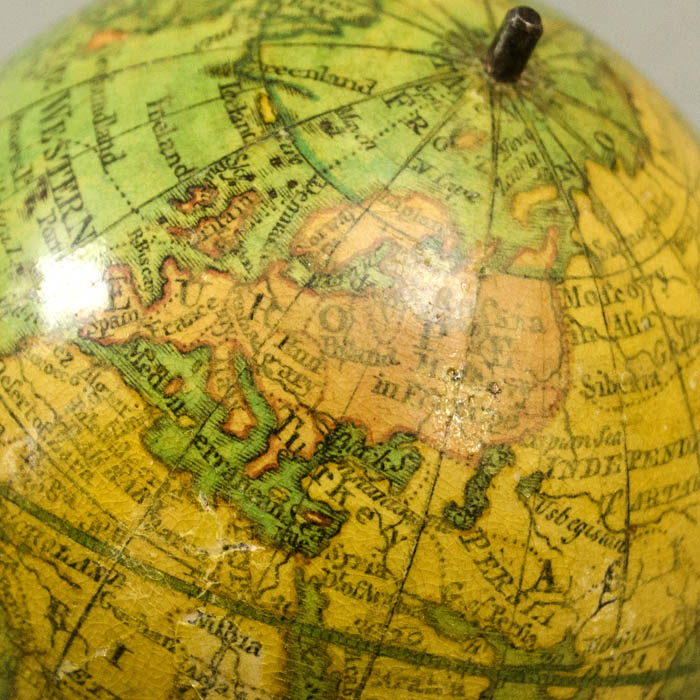
We have attributed this globe as having been produced by Nicholas Lane and successors in 1809 based on other extant examples of Lane pocket globes. For example, the cartography and typography as well as placement of the cartouche on this Harris globe is identical to an 1809 Lane pocket globe in a celestial fish skin case sold by George Glazer Gallery that has a round “Lane’s” makers’ cartouche. As is typical for Lane 1809 pocket globes, this example is made of 12 hand-colored engraved gores, colored in tones of pink, green, red, blue, and yellow, with thick outlines. Oceans are colored blue-green and show the routes of the explorers Admiral Anson and Captain Cook. The Antarctic is labeled “Frozen Ocean.” Australia is called New Holland. California is shown as a peninsula. The Great Wall of China (“Chinese Wall”) is indicated. Oceans are labeled: the Pacific as “Pacific Ocean and Great South Sea,” the Atlantic as the “Western or Atlantic Ocean” and the “Ethiopic Ocean,” and the Indian Ocean as the “Eastern Ocean.” The Antarctic and Arctic are each labeled “Frozen Ocean.” The ecliptic is graduated in days and showing the symbols of the houses of the zodiac, and the prime meridian is marked Meridian of London. The concave celestial hemispheres inside the case illustrate the constellations of the northern and southern skies as figures of classical mythology and as scientific instruments, in black outline against a solid green background.
In North America, there is an early mapping of modern-day United States, Canada, and Mexico. There are no state or country borders. Instead, there are regional place names and various geographical illustrations. The Eastern coast of the United States names N. Jersey, Maryland, Virginia, Carolina, Georgia, and Gulf of Florida, while New England is marked more generally as England. Further north, the R. St. Lawrence is illustrated and named and above it, corresponding to modern-day Quebec province, is New Britain. Towards the Arctic Circle, denoted as Arctic Circle N., there is a rudimentary mapping of Hudson and Baffin Bay, as well as the Southwestern coast of Greenland. Wales and S. Wales are also named, and further west Canad is written over modern-day Saskatchewan and Manitoba provinces. The boundaries appear to be distorted to emphasize Canadian territory; however, this may also be due to the size limitations of the pocket globe.
The Rocky Mountains range is depicted across the continent with hatch marks and includes its historic name Stony Mountains. In the interior of the continent, the territory Louisiana is outlined and named. On the Pacific Coast, two notable place names include California, depicted as a peninsula, and New Albion, the name for the continental area north of Mexico claimed by Sir Francis Drake for England in 1579. While the Drake expedition left behind no colony, his claim would have significant long-term historical consequences as its existence would serve as pretext for later national expansionist projects by the United States and Britain alike. In addition to these places, the globe also notes S. Diego, Nootka or K. Georges S’d in reference to the Nootka Sound on the coast of Vancouver Island, as well as Alaska in the Northwestern corner of the continent. The rough boundaries of modern-day Mexico are adhered to in the South, and the area is named Mexico without any further mention of sub-regions, cities, or ports.
The Lane firm, founded by Nicolas Lane (fl. 1775-1783), was a major producer of pocket globes. The first edition of the terrestrial globe offered here was issued by Lane in 1776. Dekker posits that at that time Lane might have obtained the copper plates for the celestial gores from the Cushee firm of globe makers when it was dissolved around 1775. Various updated pocket globes were produced under the Lane name by his successors during the first half of the 19th century. They were often sold by globe sellers, stationers, opticians and scientific instrument dealers, sometimes with their own name printed in the cartouche or pasted as a label over Lane’s cartouche. Various examples of Lane pocket globes marketed by outside firms are in the possession of George Glazer Gallery, with dealers’ names featured in place of Lane. Such dealers include Thomas Harris, an optician in London whose name appears on the cartouche of the offered globe, and the Schmalcalders, a father and son team of opticians and instrument makers. Another example is a Lane pocket globe in the possession of the George Glazer Gallery marketed by Jacob and Halse, having a cartouche with that seller’s name in place of the Lane cartouche.
The Harris family — Thomas Harris (d. 1837) and his son William Harris (1797-1846) — were London opticians who also sold and later produced terrestrial and celestial globes. Initially, Thomas Harris was principally an optician and mathematical instrument maker. He was joined, and then succeeded, by William in the early 19th century. According to scholar Elly Dekker, Harris & Son was in business from 1802 to 1907. The firm is known to have sold a 2.75 inch pocket terrestrial globe in a celestial case, dated 1809, under the name Harris, 47 Holborn. It was likely made for Harris by N. Lane of London based on a comparison of other N. Lane pocket globes. The firm produced a New Terrestrial Globe, as a 3-inch pocket globe in a celestial case, one extant example dated 1813, and many others issued without a date. An extant table globe is known, produced by the firm under the name W. Harris, 22 Cornhill, London. In 1820, as Thomas Harris and Son, the firm produced “A New Celestial Globe,” 12 inches in diameter. According to the cartouche of that globe the firm marketed itself as “Opticians and Globe Makers; To his Majesty and their Royal Highnesses The Dukes of Kent and Sussex.” At that time the firm’s address was 52 Great Russell Street, Bloomsbury, London.
Circular Cartouche with beaded edge: HARRIS/47/HOLBORN/LONDON/1809
Condition: The globe in very good condition overall, apparently with the original varnish and with no restorations of any damages, but with light remaining toning and war. Nonetheless, the original thick varnish layer is a bit deteriorated or abraded in a few very small areas having somewhat flaked away or having become slightly crystalized; generally these are all unobtrusive with the original printing on the globe gores under the varnish still intact but a slight roughness to the surface there. Case very good overall from the outside having a few scattered restored cracks and being slightly irregularly shaped. The printed gores on the concave insides of the case are well defined in black ink. A separation crack on the case has been professionally restored leaving a minor abrasion to the celestial map which has been professionally restored in manuscript. The case retains all 3 of its 3 eyehooks and clasps and closes completely though with only very slight shrinkage gaps where the two halves meet — a common issue with pocket globes. The various white bright spots seen in the pictures of this globe are from reflections of light; not actually present on the globe.
References:
Dekker, Elly, et al. Globes at Greenwich: A Catalogue of the Globes and Armillary Spheres in the National Maritime Museum, Greenwich. London: Oxford University Press and the National Maritime Museum, 1999. pp. 54-55, 128-129, 131, 393-394.
Dekker, Elly. “Miniature and Pocket Globes: The Gentleman’s Toy.” in Lamb, Tom and Collins, Jeremy. The World in Your Hands: An Exhibition of Globes and Planetaria. London: Christie’s, 1994. pp. 66, 76.


