

Description
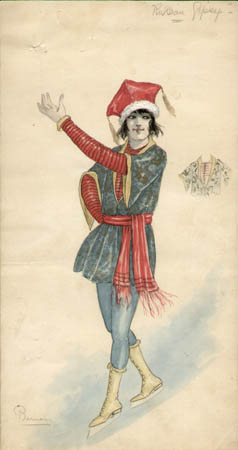
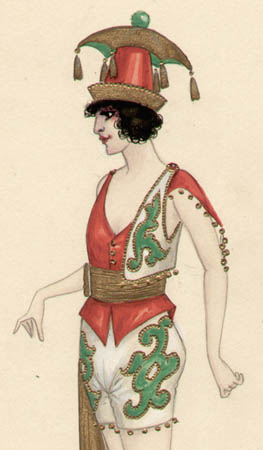
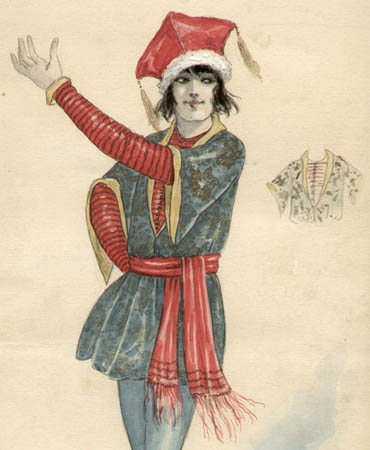
Will R. Barnes designed costumes for numerous Broadway productions between 1898 and 1924. Born in Australia, he came to the U.S. in the late 1890s and began designing costumes for a number of Joe Weber and Lew Fields’ Music Hall shows. Later he worked with the designers Cora MacGeachy and William Henry Mathews on the Hippodrome spectacles until the final show there in 1922. Some extant examples of Barnes’ designs bear his signature with his address “165 W. 48th Street, NYC” in the lower margin. This address is located in the heart of the Broadway Theater District in Midtown Manhattan. Other extant examples bear his signature with his address “27 W. 30th Street, NY” in the lower margin. Barnes specialized in costumes for the lighthearted musical entertainment that was extremely popular at the time: musical comedies, operettas, revues, vaudeville productions and burlesques. The best known of these productions today is probably Naughty Marietta, which was scored by Victor Herbert. Art historian Stefanie Munsing Winkelbauer notes that Barnes’s designs show a predilection for striking contrasts and bold pattern. The National Library of Australia and the New York Public Library have large collections of his costume designs. Barnes also was known for his watercolor landscapes.
New York City emerged at the turn of the century as a booming entertainment venue with some 41 legitimate theaters, the most in the world for a single city. The first three decades of the 20th century were the heyday of lighthearted musicals whose plots served as a contrivance to tie together lavish production numbers. According to Stefanie Munsing Winkelbauer, this booming industry supported dozens of costume designers, on whom the producers depended “to give their shows the necessary optical razzle-dazzle.” She further described the extravagance of the costumes:
No-one expected the stories to be believable or the characters to be ordinary people: in this colorful land of make-believe, innocent snobbery, royalty galore and generous bank-accounts abounded, allowing the designers’ fancies to run riot with gorgeous gowns, stunning uniforms and saucy outfits for the chorus girls. Plots, such as they were, were often confused and banal but lent themselves to numerous changes of costume often combining wildly different geographical, social or historical themes.
References:
“Will R. Barnes.” Internet Broadway Database. 2001-2010. http://www.ibdb.com/person.php?id=25434 (13 May 2010).
“Will R. Barnes Costume Designs for Alfred Hill’s Tapu.” National Library of Australia. http://nla.gov.au/nla.pic-an3703095 (13 May 2010).
Winkelbauer, Stefanie Munsing. Wake up and dream! Costume Designs for Broadway Musicals 1900-1925 from the Theatre Collection of the Austrian National Library. Vienna: Hermann Böhlaus Nachf, 1986. pp. 16-17, 22, 31-34.


