
  |
|
Click on image to view enlargement. |
|
Library Globes
During the 17th and 18th centuries, globes were purchased by wealthy European aristocrats. Existing globes from that era almost surely originally resided in a castle or mansion somewhere. The library globes pictured here have never left the Swedish castles where they are found today. |
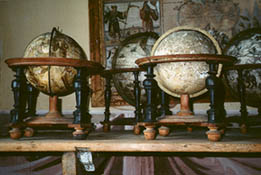 Rare 17th-century globes by Blaeu and Moxon (above) and a Blaeu celestial (right), in a Swedish castle's library.
The celestial belongs to a terrestrial and celestial pair. The Blaeu family were among the greatest cartographic publishers of the day. Read more about the firm in our Guide to Globe Makers
Rare 17th-century globes by Blaeu and Moxon (above) and a Blaeu celestial (right), in a Swedish castle's library.
The celestial belongs to a terrestrial and celestial pair. The Blaeu family were among the greatest cartographic publishers of the day. Read more about the firm in our Guide to Globe Makers |
 |
||
|
Outdoor Armillaries
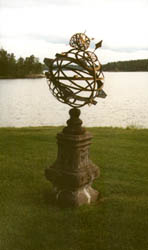
Also seen on the Swedish house tour: armillaries as rooftop and garden decoration. An armillary is a model of planetary orbits, with each ring representing the transit of a planet around the sun in the center. Garden armillaries are still made today, sometimes combined with sundials. |
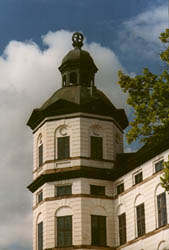 An armillary sphere at the pinnacle of a castle roof.
|
|
(near left) A large armillary on the lawn of a Swedish castle, overlooking the lake. Visitors arriving by boat would walk past this grand sculptural piece after docking on the shore. |
| Contents Next -> |
Related Links
|