Giovanni Battista Piranesi (1720-1778) (after)
Veduta degli avanzi del Tablino della Casa aurea di Nerone detti volgarmente il Tempio della Pace
[View of the Remains of the Dining Room of the Golden House of Nero Commonly Called the Temple of Peace (Basilica of Maxentius)]
from Vedute di Roma [Views of Rome]
Regia Calcografia, Rome: 1870-1945
Black-and-white etching
Regia Calcografia blindstamp, lower right
19.25 x 28 inches, plate mark
24 x 33 inches, overall
Sold, please inquire as to the availability of similar items.

Giovanni Battista Piranesi, Vedute di Roma
View of the Basilica of Maxentius and Constantine
View of the Basilica of Maxentius and Constantine
This item is sold. It has been placed here in our online archives as a service for researchers and collectors.
- Please inquire as to the availability of similar items currently in stock, or use the navigation bar above to browse our site for currently available items.
- Find guidelines for the use of images from georgeglazer.com.
- To see more archived items, view our directory.
- Find information about selling your art and antiques.
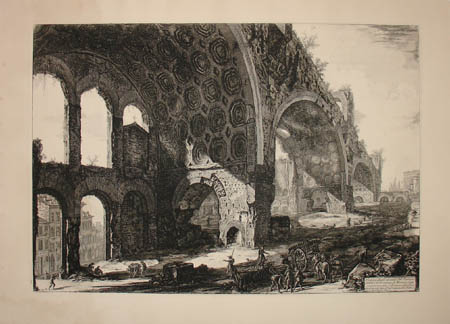
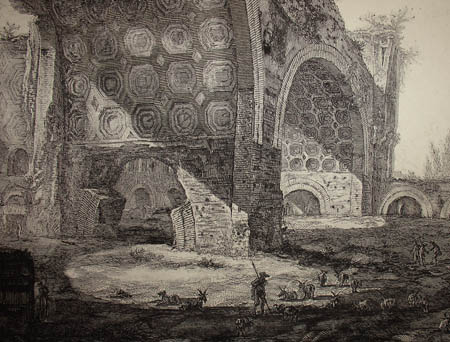
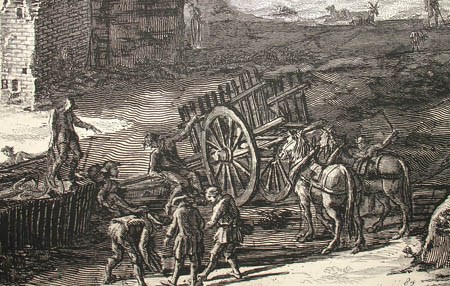
A fine etching from the Regia Calcografia edition of Giovanni Battista Piranesi’s most celebrated work, the Vedute di Roma, of the Basilica of Maxentius and Constantine. Piranesi’s title notwithstanding, the building is now understood to have had nothing to do with the Roman emperor Nero. Its construction was commenced during the reign of the Emperor Maxentius in 308 A.D. and completed in 312 under Constantine the Great. It was the largest building in the Roman forum. The dramatic view shows its massive coffered barrel vaults overhead, with plants sprouting from the walls. A group of men with horses and a cart are in the foreground, and a goatherd and his flock have stopped beneath the arch in the middle distance.
Piranesi was one of the leading figures in the development of the neoclassical style in the 18th century. His Vedute di Roma depicted the great buildings of Rome, from ancient times and the Renaissance to the mid 18th century, when many were in ruins. Their lasting popularity is due not only to the picturesque subject matter but Piranesi’s consummate artistry, command of perspective, subtle tonality, and imaginative flair. The Vedute are the largest and best known series of the prints Piranesi produced, comprising 135 plates by him and two by his son Francesco Piranesi (Hind, 5). Piranesi scholar John Wilton-Ely describes the Vedute as follows:
The 135 plates of the Vedute di Roma, produced individually by Piranesi from the late 1740s until his death some thirty years later, represent almost every phase in his stylistic evolution and reflect his changing intellectual concerns. Through these particular works, which were spread all over the Continent by means of the Grand Tour, Piranesi was not only to revolutionize the convention form of the veduta but was to transform the European vision of classical antiquity (176).
Giovanni Battista Piranesi was a multi-talented and accomplished man of the enlightenment who combined supreme artistic ability and historical scholarship with an entrepreneurial business sense. He was at once an artist, architect, archeologist, designer, collector, and print and antiquities dealer. Many consider him one of the most influential artists in the development and popularization of the neoclassical style of the late 18th century. According to scholar John Wilton-Ely, the distinguishing characteristics of Piranesi’s early works were “the unorthodox combination of classical motifs, the manipulation of superhuman scale, the organization of powerfully receding perspectives upon diagonal axes, and the modulation of space by means of skilful lighting.” Piranesi’s work was recognized with his election as a Fellow of the Society of Antiquaries in England in 1757. He was knighted by the Pope in 1765. Although Piranesi composed and etched many of his works, his son Francesco (1758-1810) and studio assistants such as Vincenzo Dolcibene also etched a significant number of the prints, especially in later years.
Piranesi etched and published numerous folio print sets of art, architecture and archaeology of Rome and environs, that served as source material for other architects and designers. They were sold as souvenirs to English aristocrats on the Grand Tour in Italy or by subscription directly to British patrons. Among those influenced by Piranesi was the great British architect Robert Adam (1728-92), who was a colleague of Piranesi while in Rome on the Grand Tour in the 1750s. From the 1760s onward, Piranesi supplemented his printing business by joining the thriving trade in the restoration and sale antiquities to Grand Tour travelers. Piranesi's interest in these objects went well beyond historical restoration and marketing -- he also advocated emulating the creativity of the Roman designers and integrating motifs from Greek and Roman antiquities with a contemporary sensibility to produce new and strikingly original works. The British were particularly good customers, so he set up his workshop and showrooms close to the British quarter of Rome. After Giovanni Battista Piranesi’s death in 1778, Francesco and another son, Pietro, continued to republish Piranesi prints and sell antiquities.
Determining the date of printing of the 135 etchings from the Vedute is exceedingly complicated for many reasons. They were published in books and sets (of various titles, not just Vedute di Roma) as well separately issued – in various printing states – from about the 1740s. Numerous other states and posthumous editions were issued after Piranesi’s death in 1778 throughout the late 18th century, and continuing in the 19th and 20th centuries. Wilton-Ely describes the earliest fixed date for publication of plates from Vedute being 1751, when 34 of the views were published by Bouchard, Rome, in another Piranesi work Le Magnificenze di Roma, though he notes that the Vedute were almost certainly earlier published in the 1740s. According to Wilton-Ely, Piranesi self-published the Vedute from 1760 to the time of his death in 1778. Historian and print expert Arthur M. Hind wrote the definitive reference book on Piranesi’s views in 1922, Giovanni Battista Piranesi: A Critical Study, in which he painstakingly attempted to distinguish the sequence and characteristics of various states of the Vedute. Piranesi prints can also be identified by characteristic watermarks of the paper makers. These are illustrated by scholar Andrew Robison in an appendix to John Wilton-Ely, Giovanni Battista Piranesi: The Complete Etchings.
The 19th century printing of the views is also complex. In 1807, the copper plates used to make the prints were sold to Firmin-Didot Frères, a Paris firm which issued them, mostly in the 1830s. Agents for the Vatican purchased the plates for the Camera Apostolica in 1839. Hence, some of the 19th century strikes of the prints are popularly referred to as the “Pope’s edition.” The plates were then transferred to the Calcografia Camerale, a venerable Roman printing press. This firm was renamed the Regia Calcografia in 1870 and operated under that name until 1945 when it became the Calcografia Nationale. Impressions were published from the Vedute plates under the imprint of Calcografia Camerale prior to 1870 and under the imprint of Regia Calcografia thereafter. The latter have an embossed blind stamp with “Regia Calcografia” and central emblem of a crown surmounted by a cross.
References:
“Giovanni Giacomo De’ Rossi.” Romamor. http://www.romamor.it/en/ancient/derossi.htm (13 May 2005).
Hind, Arthur M. Giovanni Battista Piranesi: A Critical Study. London: Holland Press, 1922 (1978 ed.).
Wilton-Ely, John. Giovanni Battista Piranesi: The Complete Etchings. San Francisco: Alan Wofsy Fine Arts, 1994. 2 volumes.