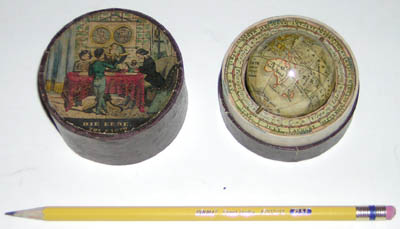
Die Erd/ The Earth
Johann Georg Klinger, Nuremberg: c. 1840s
Paperboard cylindrical box
1.75 inch terrestrial pocket globe
Case: 2.15 inches high; 2.5 inches diameter
Sold, please inquire as to the availability of similar items.
A charming miniature student's globe with text in English, in original
paperboard cylindrical case. The globe rests on metal pinions at either
pole in a full horizon band with engraved paper calendar and zodiac,
fitted and spinning in a lidded cylindrical box for display, transport
and storage. An identical example of this globe and case is in the collection
of England 's National Maritime Museum , and pictured in the book Globes
at Greenwich (pp. 384-85). The book states that an introductory
leaflet printed in English and French originally accompanied this globe.
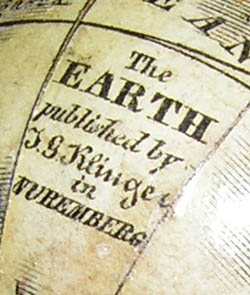
The globe shows Wilkes Land , which was discovered in 1840-42, and bears
the J.G. Klinger name, which was in use until 1852, therefore it was
probably manufactured in the 1840s.
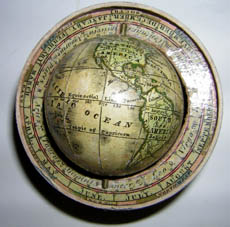
The globe is made from twelve hand-colored copper-engraved gores laid on
a solid sphere, with two brass axis pins. The equatorial is graduated
in degrees. The ecliptic is shown but not graduated. The oceans are
cream-colored with shading around the coastlines. The Antarctic is called
" Icy Sea " with coastline shown for Wilkes Land; Australia is called
New Holland; Tasmania (V. Diemans L.) is drawn as an island. The continents
are outlined and shaded in green, blue, red, yellow and orange. The
cartography is fairly general, but some towns, cities, rivers and deserts
are indicated. The horizon band of engraved paper on a removable wooden
ring shows compass directions, days of the month and of the houses of
the zodiac, and degrees in four quadrants.
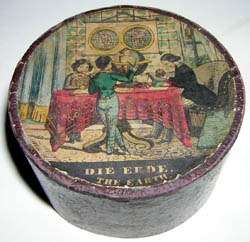
A hand-colored circular image on the box (titled DIE ERD/THE EARTH) shows
a group of three children studying geography at a draped table. An older
boy studies a small globe, another stands and points to a larger table
globe and the youngest one is apparently taking notes. A double hemisphere
wall map hangs in the background.
Johann Georg Klinger began producing globes in 1790 in Nuremberg. For more information see our Guide to Globe Makers.
Klinger produced small globes in various sizes and cases for the continental
and English market. They are often found in cylindrical paperboard cases
such as this example, or sometimes in hinged wooden boxes. For example,
a Klinger pocket globe, 2.25 inches in diameter of similar form and
markings, but in a wooden box, is illustrated in The World In
Your Hands, item 5.19. Generally the top of the box is decorated
with a lithographed image of a family, or sometimes just children examining
globes together - in this case apparently children of different ages.
Such images highlight the importance of geography as an educational
activity, as well as the central role of globes in imparting geographical
information during the mid 19th century.
Cartouche: The/ EARTH/ published by/ J.G. Klinger/ in/ NUREMBERG
Title on Box: DIE ERD/ THE EARTH
References:
Dahl, Edward H. and Gauvin, Jean-François. Sphaerae Mundi: Early Globes at the Stewart Museum. Canada: Septentrion and McGill-Queen's University Press, 2000. p. 106.
Dekker, Elly, et al. Globes at Greenwich: A Catalogue of the Globes and Armillary Spheres in the National Maritime Museum, Greenwich. London: Oxford University Press and the National Maritime Museum, 1999. pp. 384-385.
Dekker, Elly and van der Krogt, Peter. Globes from the Western World. London: Zwemmer, 1993. p. 102.
Lamb, Tom and Collins, Jeremy. The World in Your Hands: An Exhibition of Globes and Planetaria. London: Christie's, 1994. pl. 5.19.