
Late 19th Century
This item is sold. It has been placed here in our online archives as a service for researchers and collectors.
- Please inquire as to the availability of similar items currently in stock, or use the navigation bar above to browse our site for currently available items.
- Find guidelines for the use of images from georgeglazer.com.
- To see more archived items, view our directory.
- Find information about selling your art and antiques.
 |
 |
 |
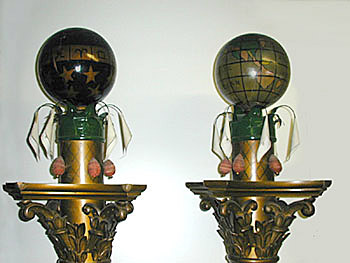
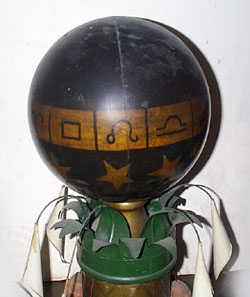
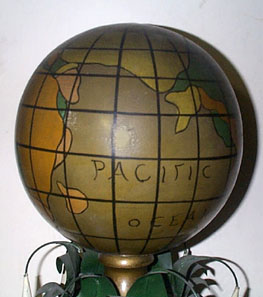
Pair of 10-inch Terrestrial and Celestial Masonic Globes on Columns American: Late 19th Century Gilt wood columnar stands with gilt iron decorated capitals, and tole decoration 83 inches high, 16 inches deep Sold, please inquire as to the availability of similar items. |
|
Hand-painted pair of solid wood globes originally made for a Masonic lodge, one terrestrial, one celestial, each turning in a pinion at the south pole set in cross-hatch painted cylinder decorated with hanging white-painted tole lily of the valley flowers suspended in green metal cap, and decorated below with orange painted wooden pomegranate fruits, each capital decorated with gilt iron acanthus leaves, supported by giltwood column with simple base on a large molded rectangular plinth decorated on each side with raised wooden figures - a "G" on the front and symbolic figures on the sides and back. Terrestrial globe with green oceans, and continents without cartographic detail shaded in a variety of colors, with lines of latitude and longitude. Celestial with gold painted stars and zodiac band on black ground.
A pair of globes atop columns are a central part of the iconography of the Masons and were used to decorate their lodges. The columns hearken back to the twin columns which are said to have been placed at the entrance of King Solomon's temple, symbolically linking the Masonic Temple with Solomon's. Generally speaking, the celestial globe is symbolic of the spiritual part of human nature, and the terrestrial globe symbolic of the material side. A lodge frequently would have a full sized pair on large columns (about six to 8 feet tall) with nine to 12-inch diameter globes. Sometimes one of the columns had a simple Ionic or Doric capital and the other to the pair had a developed Corninthian capital. Such globes, either in the miniature size or the full size, were sometimes simply painted, as here, just showing continents on the world globe and the star motif on the celestial globe. Sometimes printed globe gores were used. For the miniature, generally one finds globes by George Philip and successor to C. Smith and Sons. For large versions, often a W. & A.K. Johnston pair of terrestrial and celestial were mounted on the large columns. For more information on George Philip, please see our Guide to Globe Makers. Reference:
|